The answer
Soluble fiber dissolves in water and other body fluids and forms a gel as it passes through; insoluble fiber does not dissolve, but soaks up fluid and adds bulk to stool, Cleveland Clinic explains. Most plant foods carry both.1 For regularity, the 2023 US guideline on long-term constipation suggests fiber supplements, and psyllium, a soluble fiber, has the most trials behind it: three against placebo.5
Key numbers
- Both in one food: all plant foods carry a mix of soluble and insoluble fiber, the Linus Pauling Institute says, and USDA's record for frozen carrots splits 3.2 g of fiber per 100 g into 1.4 g soluble and 1.9 g insoluble. [Linus Pauling Institute; USDA FoodData Central]
- Food lists: Cleveland Clinic files oats, barley, beans, peas, apples, citrus fruits and carrots under soluble, and wheat bran, whole-wheat flour, nuts, berries and vegetables such as cauliflower and green beans under insoluble. [Cleveland Clinic]
- No clear winner: the 2023 US guideline on long-term constipation suggests fiber supplements, at low certainty, and finds no clear evidence that soluble or insoluble fiber is more effective. [Chang et al., 2023]
- 6 g and 2 g, soluble: the Easy Mix Fiber and Psyllium Husk Fiber panels each print a Soluble Fiber line equal to their Dietary Fiber, 6 g per heaping spoonful and 2 g per 5 capsules. [Physician's Choice labels, read Nov 9, 2026]
- Optional lines: FDA lets a Nutrition Facts panel list soluble and insoluble fiber grams under Dietary Fiber, and requires them only when the label makes a claim about one of them. [21 CFR 101.9]
What is the difference between soluble and insoluble fiber?
Whether it dissolves. Soluble fiber dissolves in water and other body fluids and forms a gel-like material on its way through, and once it reaches the colon it feeds gut bacteria, Cleveland Clinic explains. Insoluble fiber does not dissolve: it soaks up fluid and sticks to other material to form stool, which comes out softer, bulkier and more regular.1
Both kinds count as dietary fiber. FDA defines dietary fiber as soluble and insoluble carbohydrates your body does not digest, plus lignin, found intact in plants, along with isolated or synthetic fibers FDA has found to have physical effects that benefit health.7 Most foods do not pick a side, either. The Linus Pauling Institute at Oregon State University says all plant-based foods contain a mixture of soluble and insoluble fiber, and Cleveland Clinic puts beans and carrots on both of its lists.31
Which foods are high in soluble fiber, and which in insoluble?
Oats, beans, peas, barley, apples, citrus fruits and carrots are on the soluble lists; wheat bran, whole-wheat flour, brown rice, nuts, berries and vegetables are on the insoluble ones. The table gives nine everyday foods with the fiber in one serving, from USDA records, and the kind of fiber the sources file each one under.1236
Nine foods, their fiber per serving, and the kind sources name
| Food | Serving | Fiber per serving | The kind sources file it under | Named by |
|---|---|---|---|---|
| Oat bran, cookedUSDA FDC 168873 | 1 cup (219 g) | 5.7 g | Soluble | MedlinePlus, Cleveland Clinic |
| Kidney beans, boiledUSDA FDC 173740 | 1 cup (177 g) | 11.3 g | Both: beans are on the soluble and the insoluble list | Cleveland Clinic (both lists), MedlinePlus (soluble) |
| OrangeUSDA FDC 169097 | 1 fruit, 2 5/8 in across (131 g) | 3.1 g | Soluble (citrus fruits) | Cleveland Clinic |
| Carrot, rawUSDA FDC 170393 | 1 medium (61 g) | 1.7 g | Both: carrots are on the soluble and the insoluble list | Cleveland Clinic |
| Wheat bran, crudeUSDA FDC 169722 | 1/4 cup (14.5 g) | 6.2 g | Insoluble | MedlinePlus, Cleveland Clinic, Linus Pauling Institute |
| Whole-wheat breadUSDA FDC 172688 | 1 slice (32 g) | 1.9 g | Insoluble (whole-wheat flour) | Cleveland Clinic |
| Brown rice, cookedUSDA FDC 169704 | 1 cup (202 g) | 3.2 g | Insoluble | Linus Pauling Institute |
| Green beans, boiledUSDA FDC 169141 | 1 cup (125 g) | 4.0 g | Insoluble | Cleveland Clinic |
| Cauliflower, boiledUSDA FDC 170397 | 1/2 cup (62 g) | 1.4 g | Insoluble | Cleveland Clinic |
Sources: USDA FoodData Central, SR Legacy records, total dietary fiber per 100 g times each record's own portion, our arithmetic; the wheat bran serving is a quarter of the record's 58 g cup. The kind column is from Cleveland Clinic, MedlinePlus and the Linus Pauling Institute. Grams are total fiber: these records do not split it by kind.
One USDA record does split it. In its Foundation record for frozen carrots, 3.2 g of total fiber per 100 g breaks down into 1.4 g soluble and 1.9 g insoluble, so an 85 g serving holds about 1.2 g soluble and 1.6 g insoluble fiber.6 That is the pattern the sources describe: one food, both kinds. How much fiber you need in a day, in total, is in how much fiber per day?
Gel-forming or fermentable: what happens to each kind in the gut?
It depends on more than solubility. The Linus Pauling Institute sorts fiber into four kinds by three traits: whether it dissolves, whether it thickens into a gel, and whether gut bacteria ferment it. Gut bacteria ferment fiber into short-chain fatty acids and gases, so the fermentable kinds are the ones that feed gut bacteria, and the ones more likely to bring gas.3
Four kinds of fiber, by the Linus Pauling Institute's sorting
| Kind | Examples it gives | What it does in the gut, per the source |
|---|---|---|
| Soluble, gel-forming, readily fermented | Beta-glucans from oats and barley; raw guar gum | Thickens into a gel, then gut bacteria ferment it into short-chain fatty acids and gases |
| Soluble, gel-forming, not fermented | Psyllium | Holds its gel through the large intestine and can normalize stool, softening hard stool and firming loose stool |
| Soluble, not gel-forming, readily fermented | Inulin, wheat dextrin, oligosaccharides, resistant starches | Fermented by gut bacteria; can have a prebiotic effect on the mix of bacteria in the gut |
| Insoluble, poorly fermented | Wheat bran, cellulose, lignin | Does not dissolve or trap water; large, coarse particles can have a laxative effect by drawing mucus and water into stool |
Source: Linus Pauling Institute, Micronutrient Information Center, Fiber, read Nov 9, 2026.
Inulin from chicory root sits in the third row. Harvard's Nutrition Source lists it among the soluble, fermentable fibers, found in onions, chicory root, asparagus and Jerusalem artichokes, and says it may help bulk stool with a laxative effect and act as a prebiotic.4
Which fiber helps regularity and constipation: soluble or insoluble?
Both can, by different routes, and the main US guideline does not pick one. The 2023 constipation guideline written jointly by the American Gastroenterological Association and the American College of Gastroenterology backs fiber supplements, conditionally and at low certainty, for adults whose constipation is long-term, and its summary table finds no clear evidence that soluble or insoluble fiber is more effective. Psyllium, a soluble fiber, had the most trials in its review: three against placebo, run between 1986 and 1995.5
The routes differ. Insoluble fiber works by bulk: it soaks up fluid and helps form softer, bulkier stools, Cleveland Clinic says, and the Linus Pauling Institute notes that large, coarse particles such as wheat bran can have a laxative effect. Gel-forming soluble fiber works by holding water: psyllium keeps its gel through the large intestine, the institute adds.13
The guideline calls fiber supplements a first step, especially for people who eat little fiber, and says standard doses are usually taken with 8 to 10 ounces of fluid. Its advice is for long-term constipation, a condition a doctor diagnoses; this page is about everyday regularity.5 Psyllium, chicory inulin, soluble corn fiber and guar, the main fibers on Physician's Choice labels, each have a study on bowel habits, set out in soluble fiber supplements; options beyond fiber are in what helps constipation.
Does soluble or insoluble fiber cause more gas?
It depends on the fiber and on how fast you add it. Fermentable fibers make gas because gut bacteria break them down, the Linus Pauling Institute explains, and MedlinePlus says bran, an insoluble fiber, makes more gas than psyllium, a soluble one. Speed matters too: Cleveland Clinic says too much fiber too soon can lead to gas pain and bloating, so start slowly and work up.381
Physician's Choice says it plainly about its own products: Our 60 Billion Probiotic and Digestive Enzymes contain inulin, and our Fiber Gummies contain chicory root fiber; gut bacteria break down fibers like these, which can cause gas. The sources' advice is the same for any fiber: add it gradually and drink more, at least 64 ounces of fluid a day, per the Linus Pauling Institute.3 Gas from new fiber can fade as your body adjusts, MedlinePlus adds.8 Fiber types compared by how much gas they make are in fiber that doesn't cause gas.
How do soluble and insoluble fiber show up on a label?
Usually as one number. FDA requires a Dietary Fiber line, and it makes separate Soluble Fiber and Insoluble Fiber lines optional, unless the label makes a claim about one of them; then the line is required. So a panel that prints only Dietary Fiber tells you the total, not the mix.7
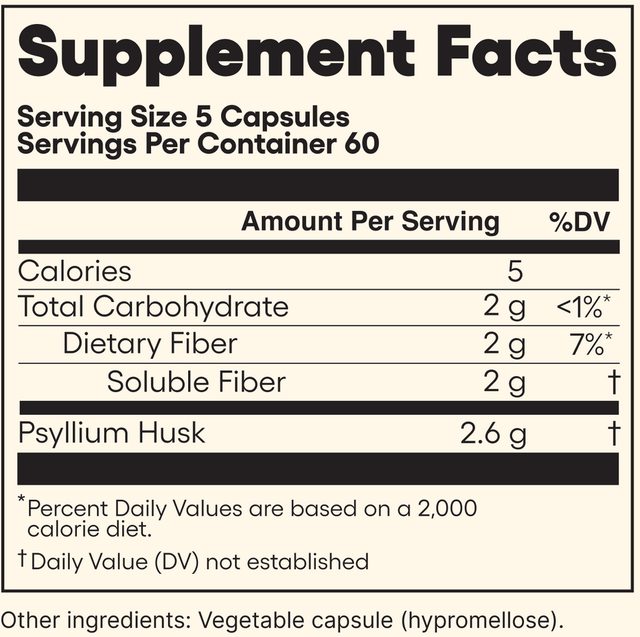
Two Physician's Choice panels print the optional line. Easy Mix Fiber lists 6 g of dietary fiber per heaping spoonful and, under it, 6 g of soluble fiber, from soluble corn fiber and guar fiber. Psyllium Husk Fiber lists 2 g of dietary fiber per 5 capsules, 2 g of it soluble, from 2.6 g of psyllium husk. Fiber Gummies print 5 g of dietary fiber per 2 gummies with no soluble line, and name chicory root fiber first among their ingredients.10
Where Physician's Choice fits
All three fiber supplements from Physician's Choice, the publisher of this site, use a soluble fiber: psyllium husk in Psyllium Husk Fiber, soluble corn fiber and guar fiber in Easy Mix Fiber, and chicory root fiber in Fiber Gummies. Physician's Choice Fiber Gummies, Easy Mix Fiber and Psyllium Husk Fiber are made to support regularity and help with occasional constipation.*
Kids Fiber Gummies list the same chicory root fiber first, at 3 g of fiber per 2 gummies, for children 4 and older under adult supervision. For all of them, the fluid line Physician's Choice uses: Drink plenty of water and other liquids when you take a fiber supplement to help keep things moving. No study cited on this page tested these products.10 How many gummies to take in a day, and when, Physician's Choice answers on its own page, how many fiber gummies a day.
In brief
Soluble fiber dissolves and turns to gel or feeds gut bacteria; insoluble fiber stays whole and bulks up stool, and most plant foods give you both. For regularity, the 2023 guideline backs fiber supplements without ranking the two kinds, with psyllium, a soluble fiber, holding the most trials. Count your total fiber, add it slowly, and drink with it.
How we reported this
- Reader questions
- In a pull of 1,145 public Reddit posts (250 communities, Sep 12 to Oct 12, 2026), 154 were tagged as fiber posts, and 1 post in the whole pull used the words soluble or insoluble; none is quoted here.
- Search question
- "Soluble vs insoluble fiber" with its neighbors, "difference between soluble and insoluble fiber," "insoluble fiber foods," "soluble fiber foods" and "which fiber for constipation," plus the follow-up questions AI assistants run on them.
- Food data
- Ten USDA FoodData Central records, read on Nov 9, 2026, with the per-serving arithmetic shown under the table.
- Label data
- The Physician's Choice Easy Mix Fiber, Psyllium Husk Fiber and Fiber Gummies panels, read on Nov 9, 2026; Kids Fiber Gummies from the Physician's Choice fact base.
- Sources
- Nine public sources, each fetched and read on Nov 9, 2026: Cleveland Clinic, two MedlinePlus pages, the Linus Pauling Institute, Harvard's Nutrition Source, the 2023 constipation guideline, USDA FoodData Central and two FDA rules. The labels are the tenth.
- House wording
- Five lines are Physician's Choice wording, used as written: the line on what the three products are made to do, the gas line, the fluid line, and the constipation and pregnancy lines in the doctor box.
Soluble and insoluble fiber, answered
Is soluble or insoluble fiber better for constipation?
Neither wins outright. The 2023 US guideline on long-term constipation found no clear evidence that one kind works better, and it suggests fiber supplements, with psyllium, a soluble fiber, backed by the most trials. Insoluble fiber adds bulk; gel-forming soluble fiber holds water. Drink plenty of fluid with either.
What foods are high in insoluble fiber?
Wheat bran, whole-wheat flour, brown rice and other whole grains, nuts, berries, and vegetables such as cauliflower and green beans, per Cleveland Clinic, MedlinePlus and the Linus Pauling Institute. A quarter cup of crude wheat bran carries 6.2 g of fiber and a cup of boiled green beans 4.0 g, by USDA records.
Is oatmeal soluble or insoluble fiber?
Both. Cleveland Clinic names oats as a source of soluble fiber, and the Linus Pauling Institute names the beta-glucans in oats as a soluble, gel-forming fiber, yet Cleveland Clinic also suggests oatmeal at breakfast for insoluble fiber. A cup of cooked oat bran carries 5.7 g of fiber, by USDA's record.
Does soluble fiber cause gas?
Some soluble fibers do, because gut bacteria ferment them, and fermentation makes gas, the Linus Pauling Institute explains. MedlinePlus says bran, an insoluble fiber, makes more gas than psyllium, a soluble one. Too much fiber too soon can lead to gas pain and bloating, Cleveland Clinic says, so add it gradually and drink more fluid.
Do I need to count soluble and insoluble fiber separately?
No. Cleveland Clinic says there is no need to track the two kinds and to focus on your total fiber instead, since most plants carry both. Most labels print only the total: FDA makes the soluble and insoluble lines optional unless the label makes a claim about one of them.
Sources
- Cleveland Clinic Health Essentials. What's the difference between soluble and insoluble fiber? With registered dietitian Gillian Culbertson, RD, LD. Feb 1, 2021. health.clevelandclinic.org
- MedlinePlus Medical Encyclopedia. Soluble vs. insoluble fiber. Review date Aug 25, 2026. medlineplus.gov
- Linus Pauling Institute, Oregon State University. Micronutrient Information Center: Fiber. lpi.oregonstate.edu
- Harvard T.H. Chan School of Public Health, The Nutrition Source. Fiber. Last reviewed April 2022. nutritionsource.hsph.harvard.edu
- Chang L, Chey WD, Imdad A, et al. American Gastroenterological Association-American College of Gastroenterology clinical practice guideline: pharmacological management of chronic idiopathic constipation. Gastroenterology. 2023;164(7):1086-1106. pmc.ncbi.nlm.nih.gov
- US Department of Agriculture, Agricultural Research Service. FoodData Central, SR Legacy records 168873 (oat bran, cooked), 173740 (kidney beans, all types, boiled), 169097 (oranges, raw), 170393 (carrots, raw), 169722 (wheat bran, crude), 172688 (bread, whole-wheat), 169704 (rice, brown, long-grain, cooked), 169141 (snap beans, green, boiled) and 170397 (cauliflower, boiled), and Foundation record 746764 (carrots, frozen). fdc.nal.usda.gov
- US Food and Drug Administration. 21 CFR 101.9, Nutrition labeling of food, paragraph (c)(6)(i). Electronic Code of Federal Regulations, current version. ecfr.gov
- MedlinePlus Medical Encyclopedia. Gas, flatulence. Review date Apr 27, 2026. medlineplus.gov
- US Food and Drug Administration. 21 CFR 201.319, Water-soluble gums, hydrophilic gums, and hydrophilic mucilloids as active ingredients; required warnings and directions. Electronic Code of Federal Regulations, current version. ecfr.gov
- Physician's Choice Supplement Facts panels: Easy Mix Fiber (label 3.1.0), Psyllium Husk Fiber (label 3.0.0) and Fiber Gummies (label 3.0.0), label images on physicianschoice.com, read Nov 9, 2026; Kids Fiber Gummies from the Physician's Choice fact base.