The answer
Most adults need 22 to 34 grams of fiber a day, depending on age and sex. The Dietary Guidelines for Americans set the goal at 14 g for every 1,000 calories, which comes to 28 g for a woman aged 19 to 30 and 34 g for a man that age. In the latest federal food survey, US men ate 17.7 g a day and women 15.0 g.
In five lines
- 14 g per 1,000 calories: the Dietary Guidelines' fiber goal, applied to the calorie level they assess for each age and sex group. [Dietary Guidelines for Americans, 2020 to 2025]
- 38 g and 25 g: the National Academies' Adequate Intakes for men and for women aged 19 to 50, falling to 30 g and 21 g from age 51. [National Academies, as USDA prints them]
- 17.7 g and 15.0 g: the average fiber men and women aged 20 and older ate in a day in 2021 to 2023. [USDA, What We Eat in America]
- 5 g a week: the most fiber a Cleveland Clinic dietitian suggests adding each week, to hold off bloating and gas on the way to your goal. [Cleveland Clinic]
- 12.5 g: the fiber in one cup of cooked chickpeas, the most per serving among the 8 foods in our USDA table. [USDA FoodData Central]
How much fiber do you need per day, by age and sex?
From 14 g for a toddler to 34 g for a young man, in the Dietary Guidelines for Americans. Their appendix sets every fiber goal at 14 g per 1,000 calories and applies it to the calorie level assessed for each age and sex group, so a woman aged 19 to 30, assessed at 2,000 calories, gets 28 g. The National Academies' Adequate Intakes, the second column for each sex, run higher for adults under 51.12
Daily fiber targets by age and sex, from two federal sources
| Age (years) | Girls and women: Guidelines goal | Girls and women: Adequate Intake | Boys and men: Guidelines goal | Boys and men: Adequate Intake |
|---|---|---|---|---|
| 1 to 3 | 14 gages 2 to 3, at 1,000 calories | 19 g | 14 gages 2 to 3, at 1,000 calories | 19 g |
| 4 to 8 | 17 gat 1,200 calories | 25 g | 20 gat 1,400 calories | 25 g |
| 9 to 13 | 22 gat 1,600 calories | 26 g | 25 gat 1,800 calories | 31 g |
| 14 to 18 | 25 gat 1,800 calories | 26 g | 31 gat 2,200 calories | 38 g |
| 19 to 30 | 28 gat 2,000 calories | 25 g | 34 gat 2,400 calories | 38 g |
| 31 to 50 | 25 gat 1,800 calories | 25 g | 31 gat 2,200 calories | 38 g |
| 51 and older | 22 gat 1,600 calories | 21 g | 28 gat 2,000 calories | 30 g |
Sources: Dietary Guidelines for Americans, 2020 to 2025, Appendix 1, Table A1-2 (source of goal: 14 g per 1,000 calories, at the calorie level assessed); the National Academies' Adequate Intakes as printed in USDA's What We Eat in America usual-intake table for fiber. Both read on Oct 26, 2026. The Guidelines' youngest group is ages 2 to 3; the Adequate Intake row is ages 1 to 3.
In pregnancy and while breastfeeding, the Guidelines goal follows the higher calorie levels assessed: 28, 34 and 36 g by trimester for women aged 19 to 30, and 34 g while breastfeeding at that age. The Adequate Intake in pregnancy is 28 g.12 The 2025 to 2030 edition of the Guidelines, the current one, prints no gram figure; it asks for fiber-rich whole grains at 2 to 4 servings a day, so the gram goals here come from the 2020 to 2025 appendix.4
Why do sources give different daily fiber numbers?
Because they quote different columns of the same federal tables. NIDDK's adult range of 22 to 34 g matches the Guidelines goals and cites them; MedlinePlus's 21 to 38 g matches the span of the Adequate Intakes, from 21 g for women over 50 to 38 g for men under 51. Physician's Choice, which publishes this site, uses one line: Adults get 25 to 38 grams of fiber per day, though exact targets depend on age and sex.56
That Physician's Choice range matches the Adequate Intakes for women and men aged 19 to 50, as USDA's tables print them.2 The two federal columns differ in method: a Guidelines goal is the 14 g rule multiplied by one set calorie level, while an Adequate Intake is a single figure for each age and sex group. MedlinePlus's patient page on high-fiber foods gives the same pair as its daily recommended intake: 38 g a day for men and 25 g for women aged 19 to 50.17
Neither number is personal. Cleveland Clinic dietitian Beth Czerwony, RD, LD, notes that "these official recommendations don't account for bodily differences like weight, height and overall health," and suggests asking a healthcare provider for individual guidance.8
How much fiber do Americans actually eat?
Well short of the goal. In What We Eat in America, the federal dietary survey for 2021 to 2023, men aged 20 and older ate 17.7 g of fiber a day on average and women 15.0 g, or 16.3 g across all adults. Cleveland Clinic puts the gap more bluntly: studies show only about 5% of US adults get enough fiber.38
Average fiber eaten in a day, by age
| Age (years) | Men | Women |
|---|---|---|
| 20 to 29 | 16.2 g | 16.3 g |
| 30 to 39 | 18.9 g | 15.0 g |
| 40 to 49 | 17.8 g | 15.8 g |
| 50 to 59 | 17.0 g | 14.4 g |
| 60 to 69 | 18.0 g | 14.4 g |
| 70 and older | 17.9 g | 14.2 g |
| All adults, 20 and older | 17.7 g | 15.0 g |
Source: USDA, What We Eat in America, NHANES August 2021 to August 2023, Table 1, mean intake from food and beverages on day 1, 2,115 men and 2,683 women aged 20 and older. Read Oct 26, 2026.
Set against the first table, a man in his twenties eats about 18 g a day less than his 34 g goal, and a woman about 12 g less than her 28 g, by our arithmetic on the nearest age bands.
Which foods have the most fiber per serving?
A legume leads the eight everyday foods below. In USDA's FoodData Central, a cup of cooked chickpeas holds 12.5 g of fiber, a cup of avocado cubes 10.1 g and a cup of blackberries 7.6 g, while a cup of cooked spinach has 4.3 g and a medium baked sweet potato 3.8 g. Each row carries its USDA record number.9
Fiber per serving in eight foods, from USDA records
| Food (USDA record) | Serving, as the record lists it | Fiber |
|---|---|---|
| Chickpeas, cooked, boiledFDC 173757 | 1 cup (164 g) | 12.5 g |
| Avocado, rawFDC 171705 | 1 cup, cubes (150 g) | 10.1 g |
| Blackberries, rawFDC 173946 | 1 cup (144 g) | 7.6 g |
| Barley, pearled, cookedFDC 170285 | 1 cup (157 g) | 6.0 g |
| Whole-wheat pasta, cookedFDC 168910 | 1 cup spaghetti, not packed (117 g) | 4.6 g |
| Spinach, cooked, boiledFDC 168463 | 1 cup (180 g) | 4.3 g |
| Popcorn, air-poppedFDC 167959 | 1 oz (28.35 g) | 4.1 g |
| Sweet potato, baked in skinFDC 168483 | 1 medium (114 g) | 3.8 g |
Each figure is the record's fiber per 100 g times the serving weight that record lists, divided by 100 and rounded to one decimal: our arithmetic. Per 100 g: chickpeas 7.6 g, avocado 6.7 g, blackberries 5.3 g, barley 3.8 g, whole-wheat pasta 3.9 g, spinach 2.4 g, popcorn 14.5 g, sweet potato 3.3 g. All eight are SR Legacy records in USDA FoodData Central, read Oct 26, 2026.
Foods that trials tested against hard stools, such as prunes and kiwifruit, are covered in foods that help constipation.
How do you add fiber without gas and bloating?
Slowly, and with more to drink. Cleveland Clinic's Beth Czerwony says to "add in no more than 5 grams of fiber per week until you reach your individual goal," and MedlinePlus spreads the increase over a few weeks to spare the stomach. NIDDK's version is to add it bit by bit and let your body adjust.865
At 5 g a week, a woman eating 15 g a day would pass a 28 g goal in about three weeks, by our arithmetic. Fluid goes with every step: MedlinePlus says water helps fiber pass through the digestive system and suggests about 8 glasses of water or noncaloric fluid a day, and NIDDK pairs more fiber with plenty of liquids.65 For supplements, Physician's Choice adds: Drink plenty of water and other liquids when you take a fiber supplement to help keep things moving. The fiber types that ferment least are compared in fiber that doesn't cause gas.
What happens if you eat too much fiber at once?
Gas, bloating and cramps, mostly. Piling on a lot of fiber quickly can bring intestinal gas, bloating and abdominal cramps, MedlinePlus says, and the trouble often settles as gut bacteria adjust. Its patient page reads new bloating or gas as a sign you went too far, and says to cut back on fiber for a few days.67
Two more cautions from MedlinePlus. Too much fiber may interfere with absorbing minerals such as iron, zinc, magnesium and calcium, though it calls this not much of a concern because high-fiber foods tend to be rich in minerals. And extra fiber without enough fluid may make constipation worse instead of better.67 No source here names an upper limit for fiber.
Where does a fiber supplement fit?
After food, as a top-up. MedlinePlus says that if your diet is balanced you likely do not need a fiber supplement. Cleveland Clinic's dietitian puts food first too, and says supplements can help if you are not able to get enough through diet, with a word from a healthcare professional before you start any supplement.78
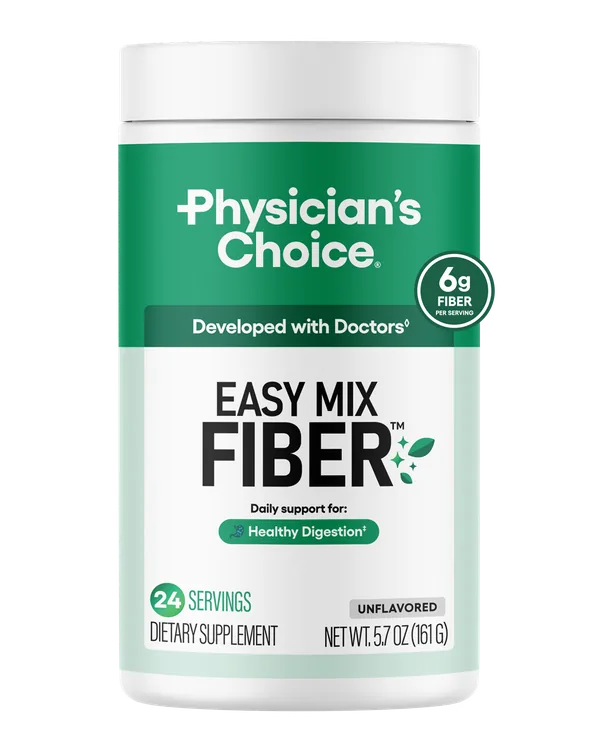
Physician's Choice, which publishes this site, makes three fiber supplements. Their panels list 6 g of fiber per heaping spoonful of Easy Mix Fiber, 5 g per 2 Fiber Gummies and 2 g per 5 capsules of Psyllium Husk Fiber, printed as 21%, 18% and 7% of the Daily Value.10 Against a 28 g goal, any one serving supplies under a quarter of the day, by our arithmetic; the rest is food's job.
None of the sources cited here tested these products. Fiber types side by side are in what is a good fiber supplement?, timing and spacing from medicines in when to take a fiber supplement, and which supplement fibers are soluble, with what a study measured for each, in soluble fiber supplements.
In brief
Most adults need 22 to 34 g of fiber a day by the Dietary Guidelines, 14 g per 1,000 calories, or 21 to 38 g by the National Academies' Adequate Intakes, yet US adults average 15 to 18 g. Close the gap with legumes, fruit, whole grains and vegetables, adding no more than about 5 g a week with plenty to drink.
How we reported this
- Reader questions
- In a pull of 1,145 public Reddit posts (250 communities, Sep 12 to Oct 12, 2026), 154 were about fiber, and 7 talked about fiber intake or grams of fiber a day. One asked it plainly: "How do you guys meet your fiber intake, i have carb heavy diet" (Public Reddit post, r/Supplements, Oct 2026). It frames the question; it is not a product review.
- Search question
- "How much fiber per day?" with its neighbors, "how much fiber daily" and fiber per day by age and sex, plus the follow-up AI assistants run on what Americans eat and how to add more.
- Label facts
- The Easy Mix Fiber, Fiber Gummies and Psyllium Husk Fiber panels, as their label images on physicianschoice.com showed them on Oct 26, 2026.
- Sources
- Nine public sources, each fetched and read on Oct 26, 2026: both editions of the Dietary Guidelines, two USDA survey tables, eight USDA FoodData Central records, NIDDK, two MedlinePlus pages and Cleveland Clinic. Brand names in the sources are left out.
- House wording
- Four lines come from Physician's Choice word for word: the adult daily range, the fluid line with supplements, and the constipation and pregnancy lines in the box beside this answer.
Daily fiber questions, answered
How much fiber should I eat a day?
Most adults need 22 to 34 g a day under the Dietary Guidelines, depending on age and sex: 25 to 28 g for women under 51 and 31 to 34 g for men under 51, a little less after 50. The National Academies' Adequate Intakes are 25 g for women and 38 g for men aged 19 to 50.
How much fiber does a woman need per day?
For women aged 19 to 30 the Dietary Guidelines goal is 28 g a day, then 25 g to age 50 and 22 g after. The National Academies' Adequate Intake is 25 g up to age 50 and 21 g after. In pregnancy, the Guidelines goal for women aged 19 to 30 is 28 to 36 g, by trimester.
How much fiber does a man need per day?
The Dietary Guidelines set 34 g a day for men aged 19 to 30, then 31 g up to age 50 and 28 g after that. The National Academies' Adequate Intake is 38 g up to age 50 and 30 g after. In the 2021 to 2023 national survey, men aged 20 and older ate 17.7 g a day.
How much fiber do children need?
The Dietary Guidelines set 14 g a day for ages 2 to 3, then 17 to 20 g for ages 4 to 8, 22 to 25 g for ages 9 to 13 and 25 to 31 g for ages 14 to 18, depending on sex. MedlinePlus notes that younger children cannot eat enough calories to reach adult amounts.
Can you eat too much fiber?
Too much too fast, yes. MedlinePlus links a quick, large jump in fiber to gas, bloating and cramps, and says too much fiber may get in the way of absorbing minerals such as iron and zinc. No source here names an upper limit; they advise adding fiber slowly with plenty of fluids.
Sources
- US Department of Agriculture and US Department of Health and Human Services. Dietary Guidelines for Americans, 2020-2025, 9th edition. Appendix 1, Tables A1-2 and A1-3 (and A1-4 for breastfeeding). dietaryguidelines.gov (PDF)
- USDA Agricultural Research Service. Dietary fiber (g): usual intakes from food and water, 2003-2006, compared to Adequate Intakes. What We Eat in America, NHANES 2003-2006. Used here only for its Adequate Intake column, which cites the Institute of Medicine (National Academies) macronutrient report. ars.usda.gov (PDF)
- USDA Agricultural Research Service. What We Eat in America, NHANES August 2021-August 2023. Table 1: nutrient intakes from food and beverages, mean amounts consumed per individual, by male/female and age. ars.usda.gov (PDF)
- US Department of Agriculture and US Department of Health and Human Services. Dietary Guidelines for Americans, 2025-2030. realfood.gov (PDF), linked from dietaryguidelines.gov
- NIDDK (National Institutes of Health). Eating, diet, and nutrition for constipation. Last reviewed May 2018. niddk.nih.gov
- MedlinePlus Medical Encyclopedia. Fiber. Review date Jul 22, 2026. medlineplus.gov
- MedlinePlus patient instructions. High-fiber foods. Review date Jul 20, 2026. medlineplus.gov
- Cleveland Clinic Health Essentials. How much fiber do you need per day? With registered dietitian Beth Czerwony, RD, LD. Published Apr 30, 2025. health.clevelandclinic.org
- USDA FoodData Central, SR Legacy records 173757 (chickpeas, cooked, boiled, without salt), 171705 (avocados, raw, all commercial varieties), 173946 (blackberries, raw), 170285 (barley, pearled, cooked), 168910 (pasta, whole-wheat, cooked), 168463 (spinach, cooked, boiled, drained, without salt), 167959 (snacks, popcorn, air-popped) and 168483 (sweet potato, cooked, baked in skin, flesh, without salt). fdc.nal.usda.gov
- Physician's Choice Supplement Facts panels: Easy Mix Fiber (label 3.1.0), Fiber Gummies (label 3.0.0) and Psyllium Husk Fiber (label 3.0.0), label images on physicianschoice.com. Read Oct 26, 2026. The label figures on this page are copied from those panels; the lines on daily fiber, fluid and constipation are Physician's Choice wording, used as written.