The answer
Check grams of fiber first: MedlinePlus sets 21 to 38 g a day for adults. A prebiotic printed in milligrams, like 150 mg, is 0.15 g, not a fiber serving. Then check the probiotic for a strain code and a CFU count at the end of shelf life, as NIH advises. Physician's Choice Probiotic Gummies list 3 g fiber and 1 billion CFU B. subtilis per 2 gummies.
Key facts
- 21 to 38 g of fiber a day is the adult target, and Americans average about 16 g. [MedlinePlus]
- 0.15 g is what a 150 mg prebiotic blend adds, under 1 percent of 21 g. [60 Billion Probiotic label; arithmetic]
- 3 g fiber, 1 billion CFU of Bacillus subtilis and 0 g sugar per 2 Probiotic Gummies; no strain code is printed. [Physician's Choice label, checked Oct 8, 2026]
- End of shelf life is when NIH says the CFU count should be stated, not the time of manufacture. [NIH Office of Dietary Supplements]
- 6 g FOS or 8 g pectin per dose: the fiber amounts in two fiber plus probiotic pairs from the functional constipation section of WGO's 2023 guideline. [World Gastroenterology Organisation]
How many grams of fiber do adults need a day? (MedlinePlus)
Between 21 and 38 grams, MedlinePlus says, for older children, teens and adults. The average American eats about 16, so the average American is 5 to 22 grams short.
Hold any combination product against that gap. A supplement that adds 3 g closes part of it; a capsule that adds 0.15 g barely registers. The chart puts one serving of six Physician's Choice labels on one scale.
One serving, on the grams ruler
Fiber per serving as printed, against the adult target. Red bars are prebiotics printed in milligrams.
Sources: MedlinePlus (target and average); Physician's Choice labels, checked Oct 8, 2026.
MedlinePlus adds two cautions: a lot of fiber in a short time can cause gas, bloating and cramps, and water helps fiber pass through the digestive system.
"Add fiber gradually over a period of a few weeks to avoid stomach distress."
MedlinePlus Medical Encyclopedia, Fiber, updated Sep 15, 2026
Which fibers make more gas than others is a separate question, covered in our guide Fiber that doesn't cause gas.
Is a prebiotic in milligrams the same as a fiber serving?
No. A milligram is a thousandth of a gram, so 150 mg of prebiotic is 0.15 g of fiber. A fiber serving is counted in whole grams.
Physician's Choice 60 Billion Probiotic lists a 150 mg blend of organic Jerusalem artichoke inulin, organic acacia fiber and organic chicory inulin. Prebiotic Probiotic lists 250 mg of chicory inulin next to its 10 billion CFU. Those lines name the prebiotic. Against a 21 to 38 g fiber target, they round to almost nothing.
The reverse holds too. ISAPP, the scientific group behind the consensus definition of a prebiotic, says plainly that not all dietary fibers are prebiotics. Grams of fiber and milligrams of prebiotic answer different questions.
Fiber and probiotic per serving, by product type
| Product type | Physician's Choice example | Fiber per serving | Probiotic per serving | Share of 21 to 38 g |
|---|---|---|---|---|
| Fiber + probiotic gummy | Probiotic Gummies, 2 gummies | 3 g | Bacillus subtilis, 1 billion CFU | 8 to 14% |
| Probiotic capsule with a prebiotic | Prebiotic Probiotic, 1 capsule | 0.25 g inulin | 10 billion CFU, 3 Lactobacillus species | about 1% |
| Probiotic capsule with a prebiotic blend | 60 Billion Probiotic, 1 capsule | 0.15 g blend | Listed separately on the label | under 1% |
| Fiber powder | Easy Mix Fiber, 1 heaping spoonful | 6 g, all soluble | None | 16 to 29% |
| Fiber gummy | Fiber Gummies, 2 gummies | 5 g | None | 13 to 24% |
| Fiber capsule | Psyllium Husk Fiber, 5 capsules | 2 g | None | 5 to 10% |
Sources: Physician's Choice Supplement Facts panels, checked against the label images on physicianschoice.com on Oct 8, 2026; share computed against the MedlinePlus range of 21 to 38 g a day.
What does NIH say to check on the probiotic side? Strain, CFU and expiration
Three things: the full strain name with its code, the CFU count, and whether that count holds to the end of shelf life.
NIH's Office of Dietary Supplements says probiotics are identified by their genus, species and strain designation, and that users should look for products labeled with the number of CFU at the end of the product's shelf life, not at the time of manufacture. It adds that products with higher CFU counts are not necessarily more effective than products with a lower count.
Read Probiotic Gummies against that list. The panel prints Bacillus subtilis at 1 billion CFU per 2 gummies, with no strain code and no counting date. Both are open questions we have put to Physician's Choice. Its fiber and sugar lines sit next to two other gummy panels in fiber gummies without the candy.
Why a Bacillus in a gummy? B. subtilis forms spores, and a Cleveland Clinic dietitian suggests spore forms for anyone who does take a supplement. That explains the species; it does not replace a strain code.
"Probiotic in spore form (for example, Bacillus coagulans, Bacillus subtilis), which can survive on the shelf or in the digestive tract"
Gail Cresci, PhD, RD, Cleveland Clinic Health Essentials, Mar 21, 2025
Which fibers count as dietary fiber on a label? (FDA)
FDA counts psyllium husk, guar gum, pectin and a few other added fibers it has reviewed. Inulin, resistant dextrin and acacia are on a list FDA intends to add, and makers may count them in the meantime.
To make FDA's list, an added fiber has to show a benefit, such as more frequent bowel movements. Fibers naturally part of whole foods count without that review.
So read the Dietary Fiber line in grams before the front of the pack. An ingredient name tells you the source: Easy Mix Fiber uses soluble corn fiber and guar fiber, Fiber Gummies use chicory root fiber, and Psyllium Husk Fiber uses 2.6 g of psyllium husk for its 2 g of fiber. The name does not tell you how fast a fiber ferments. Our guide what is a good fiber supplement sorts the common supplement fibers by that and by whether they gel. Why psyllium also appears on Drug Facts labels, and what a 5-capsule serving holds, is explained in our guide to psyllium fiber supplements.
What did studies of fiber plus probiotic pairs use? (WGO 2023)
Grams of fiber with named strains. The World Gastroenterology Organisation's 2023 adult table lists several fiber or prebiotic plus probiotic pairs. In its functional constipation section, two pair a gram dose of a fiber with named strains; the others there use lactulose or a milligram dose of FOS.
Two fiber plus probiotic pairs from WGO's 2023 functional constipation table
| Pair | Fiber per dose | Probiotic per dose | How often | Evidence level |
|---|---|---|---|---|
| FOS with L. paracasei Lpc-37, L. rhamnosus HN001, L. acidophilus NCFM and B. lactis HN019 | 6 g FOS | 100 million to 1 billion CFU | Once daily | 3: one randomized trial, in constipated women |
| Pectin with B. longum, L. acidophilus and E. faecalis | 8 g pectin | 1 billion CFU of each strain | Twice daily | 3: one randomized trial, in patients with slow-transit constipation |
Source: World Gastroenterology Organisation Global Guideline, Probiotics and prebiotics, February 2023, Table 8 (adult indications), functional constipation section; the populations are as WGO describes them. In WGO's scale, level 3 means support from a single randomized controlled trial.
WGO is careful about its table: "Doses shown are those used in the RCTs," and there is no evidence from comparative studies to rank them. Neither strain set matches Physician's Choice Probiotic Gummies, and its 3 g of fiber is half the smaller of the two fiber doses, so these trials say nothing about that product.
One product or two? When to take fiber and a probiotic separately
If you need more than a few extra grams of fiber, a combination product rarely carries enough. A separate fiber lets you set the grams.
Combination products are often sold as synbiotics. In NCCIH's words, "Synbiotics are products that combine probiotics and prebiotics." The word does not tell you the grams.
Which setup fits you
| Setup | Fits if | Look for | Skip if |
|---|---|---|---|
| One combination product | You need only a few extra grams and want one daily step | Fiber in grams, a strain code, CFU at the end of shelf life | The fiber line is in milligrams, or you need 10 g or more |
| A fiber supplement plus a separate probiotic | You want to raise fiber slowly while the probiotic stays the same | Grams per serving on the fiber; strain code and CFU basis on the probiotic | Two products a day is more than you will keep up |
| Food first, supplement later | You are new to fiber or well below 21 g a day | Cereals, dried beans and peas, fruits, vegetables and whole grains (MedlinePlus) | Not a step to skip |
Based on MedlinePlus (fiber target and foods) and NIH's Office of Dietary Supplements (strain and CFU). No source we found compares one setup against the other.
Going the two-product route? Our guide to when to take a fiber supplement covers the hour, the glass of water and which medicines to keep apart from psyllium.
Physician's Choice fiber labels, gram by gram
Physician's Choice, the publisher of this site, makes one product that pairs fiber with a probiotic: Probiotic Gummies, with 3 g of fiber, 1 billion CFU of Bacillus subtilis and 20 mcg of vitamin D3 per 2 gummies. For the separate route, Easy Mix Fiber gives 6 g of soluble fiber per heaping spoonful and Psyllium Husk Fiber 2 g per 5 capsules. Which one fits depends on how many grams you need to add.
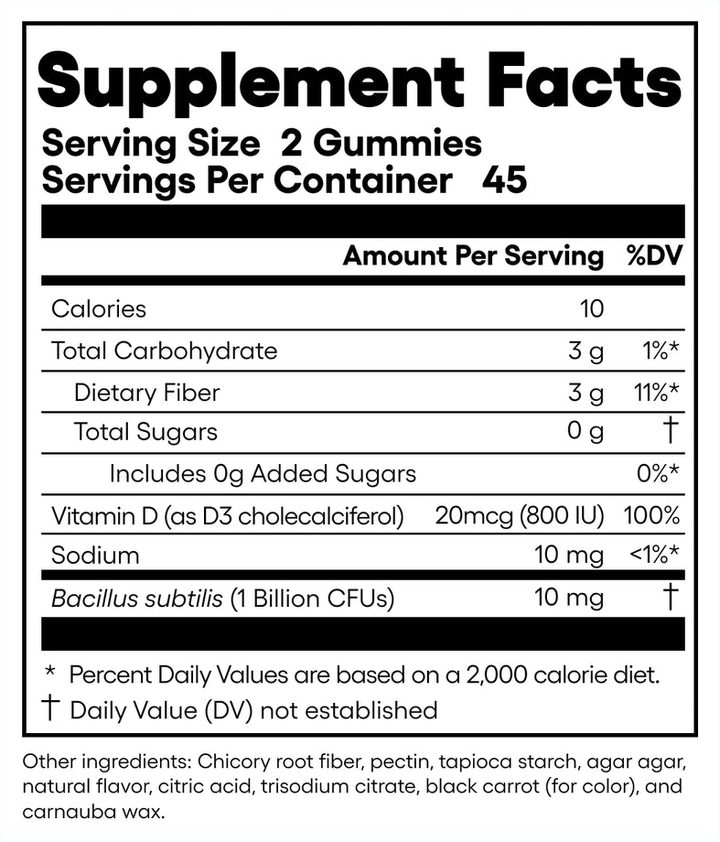
See the label
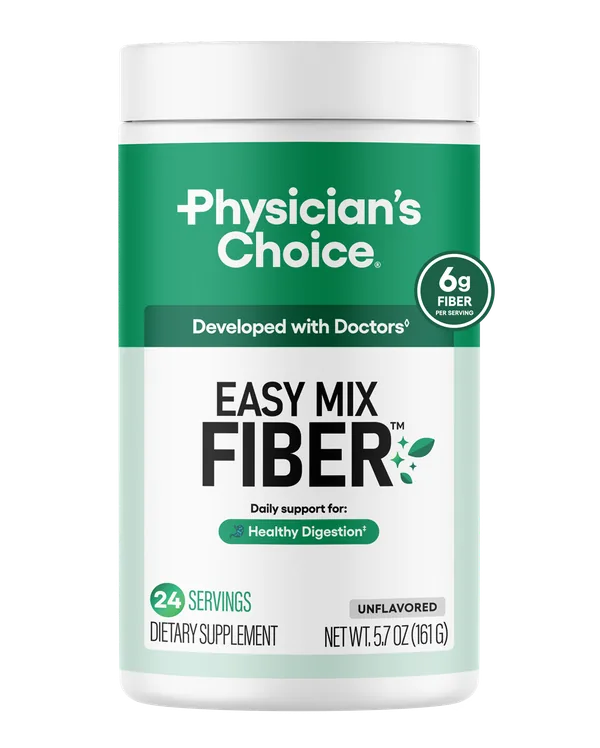
See the label
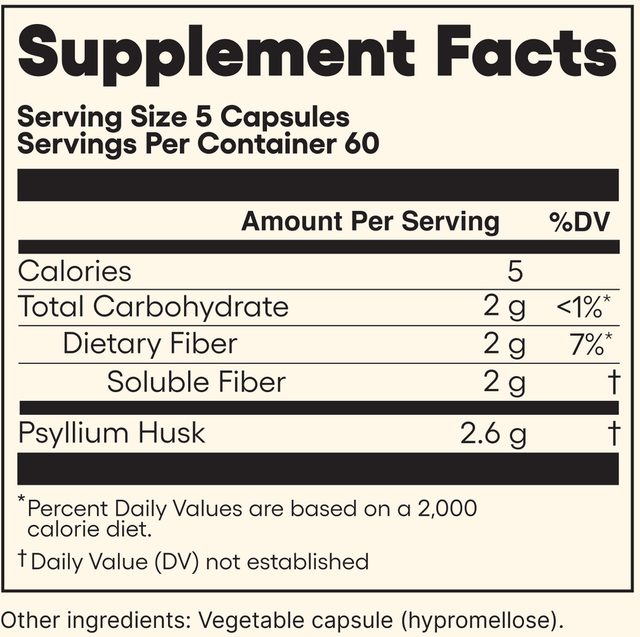
Label read Oct 10, 2026
Being confirmed with Physician's Choice: the strain designation of the Bacillus subtilis in Probiotic Gummies, and whether its CFU is counted at manufacture or at the end of shelf life.
How we reported this
- Reader questions
- A pull of 1,031 public Reddit posts from 228 communities, Sep 5 to Oct 5, 2026. Of those, 143 dealt with fiber, 2 used the words fiber and probiotics in the same post, and 3 mentioned gummies.
- Search question
- A question we put to AI answer engines each week. Their follow-up searches became this page's headings.
- Label facts
- From Physician's Choice Supplement Facts panels, checked against the label images on physicianschoice.com on Oct 8, 2026.
- Sources
- Nine public sources, each fetched and read on Oct 8, 2026, listed below. Trial findings carry their evidence level.
- Rechecks
- Label numbers are checked again on a set cycle, and sooner if a label is reprinted.
Common questions
What should I look for in fiber gummies for regularity?
Grams of fiber per serving, the fiber type and the sugar line. Physician's Choice Fiber Gummies list 5 g of fiber from chicory root fiber per 2 gummies, with under 1 g total sugars. That covers 13 to 24 percent of the 21 to 38 g MedlinePlus advises, so food still has to supply most of the rest.
Which fiber supplement is least likely to cause gas?
Our guide to fiber that doesn't cause gas compares how psyllium, inulin and wheat dextrin ferment, using a lab model and a 17-person trial. Whichever you choose, MedlinePlus advises adding fiber gradually over a few weeks. On the labels, Psyllium Husk Fiber gives 2 g per 5 capsules and Easy Mix Fiber 6 g per heaping spoonful.
Can I take a fiber supplement and a probiotic at the same time?
We found no official guidance on spacing them. NIH suggests asking your health care provider which probiotic to choose, what dose to take and how long to use it. MedlinePlus adds two rules for the fiber: raise it gradually, and drink plenty of fluids, about 8 glasses a day.
Is inulin a fiber?
On US labels it can be counted as one. FDA lists inulin and inulin-type fructans among the fibers it intends to add to its dietary fiber definition, and lets makers count them in the meantime. In milligram amounts it adds little: 250 mg of inulin is 0.25 g of fiber.
Sources
- MedlinePlus Medical Encyclopedia. Fiber. Updated Sep 15, 2026. medlineplus.gov/ency/article/002470.htm
- MedlinePlus. Dietary fiber. medlineplus.gov/dietaryfiber.html
- NIH Office of Dietary Supplements. Probiotics: fact sheet for health professionals. Updated Mar 25, 2025. ods.od.nih.gov
- NIH Office of Dietary Supplements. Probiotics: fact sheet for consumers. Updated Nov 17, 2025. ods.od.nih.gov
- FDA. Questions and answers on dietary fiber. fda.gov
- International Scientific Association for Probiotics and Prebiotics (ISAPP). Prebiotics. isappscience.org/topic/prebiotics
- World Gastroenterology Organisation. Global Guideline: Probiotics and prebiotics. February 2023. worldgastroenterology.org (PDF)
- Cleveland Clinic Health Essentials. Prebiotics vs. probiotics: what's the difference? Mar 21, 2025. health.clevelandclinic.org
- NCCIH. Probiotics: usefulness and safety. nccih.nih.gov
- Physician's Choice product labels: Probiotic Gummies, Easy Mix Fiber, Psyllium Husk Fiber (label image), Prebiotic Probiotic, 60 Billion Probiotic. Label images checked Oct 8, 2026.