The answer
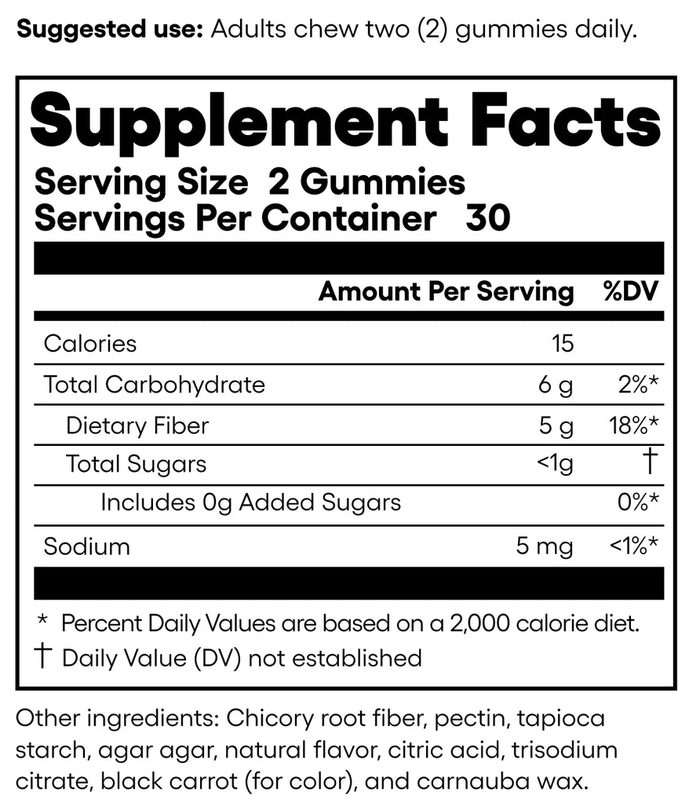
On a fiber gummy panel, read three lines per serving: Dietary Fiber, Total Sugars and Includes Added Sugars, which FDA counts inside Total Sugars. Check the ingredient list for sweeteners, then divide by the serving size for grams per gummy. Physician's Choice Fiber Gummies print 5 g of fiber, under 1 g of total sugars and 0 g of added sugars per 2 gummies.
Key facts
- Under 0.5 g of sugars per serving is one of FDA's conditions for a "sugar free" claim. [FDA, 21 CFR 101.60]
- "Includes": added sugars on the panel are already counted inside Total Sugars, not on top of them. [FDA]
- 28 g is FDA's Daily Value for dietary fiber; 20% DV or more per serving counts as high, 5% DV or less as low. [FDA]
- Sugar Alcohol is an optional panel line for sweeteners such as sorbitol, xylitol and mannitol, required only when a label makes certain claims. [FDA, 21 CFR 101.9 and 101.36]
- 5 g fiber, under 1 g total sugars, 0 g added sugars per 2 gummies, from chicory root fiber and pectin: the Physician's Choice Fiber Gummies panel. [Physician's Choice label, read Oct 12, 2026]
What do the sugar and fiber lines on a gummy panel tell you?
Each line is a gram count for one serving, and two of them sit inside a third. Read them top to bottom.
A fiber gummy sold as a dietary supplement carries a Supplement Facts panel, with its carbohydrate lines in the order and indentation FDA sets for food labels. FDA's supplement rule lists total carbohydrate, dietary fiber, total sugars and added sugars among the lines to declare when present, and makes sugar alcohol optional.
Fiber has a legal meaning there. FDA calls dietary fiber "a type of carbohydrate made up of many sugar molecules linked together" that "cannot be easily digested in the small intestine." Added fiber counts only if FDA has reviewed it as one of the "isolated or synthetic non-digestible carbohydrates (with 3 or more monomeric units) determined by FDA to have physiological effects that are beneficial to human health."
The carbohydrate lines on a gummy panel, read against one real label
| Label line | What it tells you | Physician's Choice Fiber Gummies, as printed |
|---|---|---|
| Serving Size | Every gram below is for this many gummies | 2 gummies; 30 servings, 60 gummies |
| Total Carbohydrate | All carbohydrate; fiber and sugars are indented under it as parts of it | 6 g (2% DV), of which 5 g is dietary fiber |
| Dietary Fiber | Fiber in plant foods plus added fibers FDA has reviewed, against a 28 g Daily Value | 5 g (18% DV) |
| Total Sugars | Natural plus added sugars, with no Daily Value. "Less than 1 gram" means under a gram, amount not given | <1 g |
| Includes Added Sugars | The part of Total Sugars added in making the product. Daily Value: 50 g | 0 g (0% DV) |
| Sugar Alcohol | Optional on most panels; sugar alcohols are counted here, not as sugars | No Sugar Alcohol line on the panel |
| Other ingredients | Every ingredient, in descending order by weight; sweeteners show up here | Chicory root fiber, pectin, tapioca starch, agar agar, natural flavor, citric acid, trisodium citrate, black carrot (for color), carnauba wax; formulated without artificial sweeteners, per the panel |
Sources: FDA, 21 CFR 101.9 and 101.36, and FDA's pages on added sugars and dietary fiber. Physician's Choice Fiber Gummies Supplement Facts panel, read on physicianschoice.com on Oct 12, 2026.
The two fibers on that ingredient list sit on different FDA lists. Pectin is one of the added fibers FDA names as "meeting the dietary fiber definition." Inulin and inulin-type fructans are on a second list FDA intends to add, and meanwhile it "intends to exercise enforcement discretion" so makers can count them. The panel does not say whether its chicory root fiber is inulin, so this page places it on neither list.
What does "sugar free" mean on a gummy label?
A defined claim, not a description. FDA ties "sugar free" to a gram limit per serving, to the ingredient list and to how calories are labeled.
Under FDA's rule for sugar claims, a food may say "sugar free," "no sugar" or "zero sugar" only if it "contains less than 0.5 g of sugars, as defined in § 101.9(c)(6)(ii), per reference amount customarily consumed and per labeled serving." It also needs no ingredient that is a sugar, unless an asterisk marks that ingredient as adding a trivial amount, and it must either meet FDA's low calorie terms or carry a statement such as "not a low calorie food."
"No added sugar" is a separate claim: no sugars, and no ingredient containing sugars that stands in for them, may be added during processing or packaging. So a panel can show 0 g of added sugars and still list some total sugars.
Two rounding rules explain the small numbers. When a serving has less than 1 gram of sugars, FDA lets the panel say "less than 1 gram," and when it has less than 0.5 gram, the amount "may be expressed as zero." And when sugar alcohols are in a food whose label makes a claim about sugars, the Sugar Alcohol line becomes required; on a supplement panel, it becomes required when the label makes a claim about sugar alcohols.
Which sweeteners can a fiber gummy use, and where do they show up?
Sugars, sugar alcohols, allulose and stevia-type sweeteners each land in a different place on the label.
Four kinds of sweetener and where each appears
| Sweetener type | What FDA or NIH says | Where it shows on the label | Gas or laxative note, as the source states it |
|---|---|---|---|
| Sugars: sucrose, dextrose, syrups, honey, juice concentrates | Added sugars "include sugars that are added during the processing of foods (such as sucrose or dextrose)," plus syrups, honey and juice concentrates (FDA) | Total Sugars and Includes Added Sugars | None in the sources on this page |
| Sugar alcohols: sorbitol, xylitol, lactitol, mannitol, erythritol, maltitol | FDA permits them as sugar substitutes; "The sweetness of sugar alcohols varies from 25% to 100% as sweet as sugar." (FDA) | Sugar Alcohol line when declared, and the ingredient list | NIDDK lists candy and gum made with them among foods that may lead to excess gas. Foods likely to supply 50 grams of sorbitol a day must say "Excess consumption may have a laxative effect." (FDA) |
| Allulose | A sugar the body uses differently; FDA guidance lets makers leave it out of both sugar lines, at 0.4 calories per gram (FDA) | The ingredient list | None in the sources on this page |
| Stevia and monk fruit | Steviol glycosides are "reported to be 200 to 400 times sweeter than table sugar"; monk fruit extract 100 to 250 times. Crude stevia extracts are not permitted as sweeteners (FDA) | The ingredient list | None in the sources on this page |
Sources: FDA, Aspartame and Other Sweeteners in Food; FDA allulose guidance, Oct 2020; FDA, Added Sugars on the Nutrition Facts Label; 21 CFR 184.1835; NIDDK, Eating, Diet, and Nutrition for Gas in the Digestive Tract.
On the Physician's Choice Fiber Gummies panel, the ingredient list names none of these sweeteners, no Sugar Alcohol line is printed, and the panel says the gummies are formulated without artificial sweeteners.
Gas can also come from the fiber itself. Physician's Choice says so in its own words: "Our 60 Billion Probiotic and Digestive Enzymes contain inulin, and our Fiber Gummies contain chicory root fiber; gut bacteria break down fibers like these, which can cause gas." How much gas different fiber types make, gram for gram, is in our guide to fiber that doesn't cause gas.
How do you compare fiber grams per serving and per gummy?
Start with grams per serving, then divide by the number of gummies in that serving. Serving sizes differ, so per gummy is the fairer comparison.
A serving can be one gummy, two or more, and the Dietary Fiber line covers the whole serving. Divide it out: 5 g in a 2-gummy serving is 2.5 g per gummy, while the same 5 g spread over 3 gummies would be about 1.7 g each.
Three Physician's Choice gummies, per serving and per gummy
| Gummy | Serving, as printed | Fiber per serving | Fiber per gummy | Sugar lines, as printed |
|---|---|---|---|---|
| Fiber Gummies | 2 gummies; adults chew 2 daily; 30 servings | 5 g (18% DV) | 2.5 g | <1 g total sugars; 0 g added sugars |
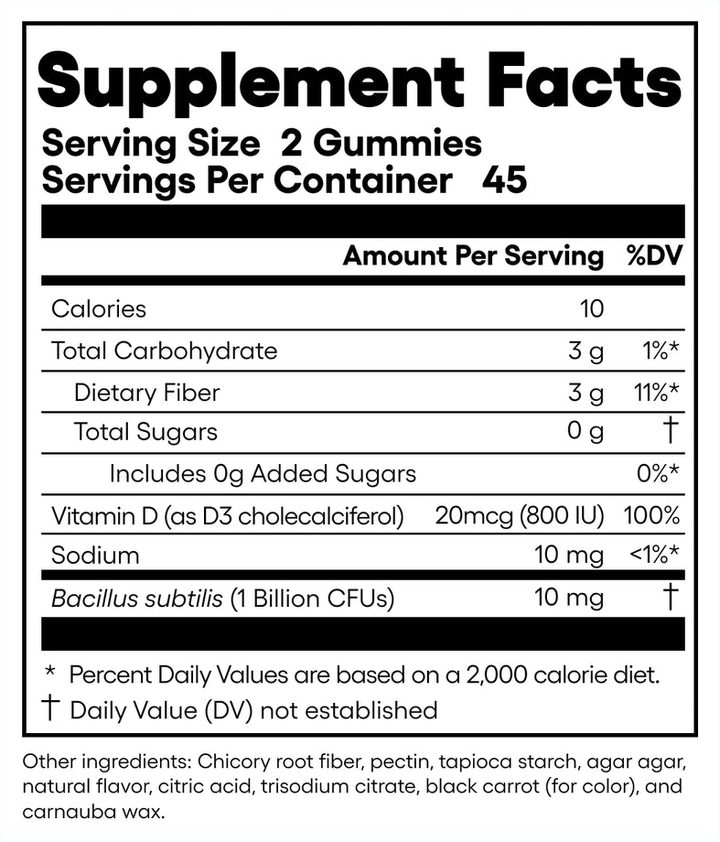
| Probiotic Gummies | 2 gummies; 45 servings | 3 g | 1.5 g | 0 g sugar |
| Kids Fiber Gummies | 2 gummies, for ages 4+, under adult supervision; 30 servings | 3 g | 1.5 g | 0 g sugars |
Sources: the three Physician's Choice panels, read on physicianschoice.com on Oct 12, 2026. Per-gummy figures are our arithmetic.
Then set the serving against a whole day. Adults get 25 to 38 grams of fiber per day, though exact targets depend on age and sex. By our arithmetic, a 5 g serving covers 13 to 20 percent of that range, which leaves most of the day's fiber to food. To weigh a gummy against a powder or a capsule by fiber type, see what is a good fiber supplement.
Physician's Choice puts the fluid advice in one line: "Drink plenty of water and other liquids when you take a fiber supplement to help keep things moving."
Where Physician's Choice fits
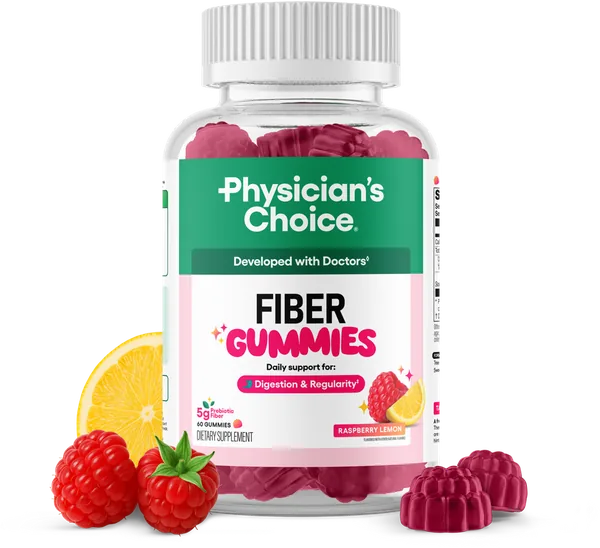
Physician's Choice, the publisher of this site, makes three gummies with fiber on the label. Fiber Gummies list 5 g of dietary fiber from chicory root fiber and pectin per 2 gummies, with 15 calories and 6 g of total carbohydrate; adults chew 2 gummies daily. The panel calls them vegan and formulated without gelatin, color additives, artificial sweeteners or flavors, and notes that they are third-party tested and made in the USA in a cGMP certified facility. Probiotic Gummies and Kids Fiber Gummies list 3 g of fiber per 2 gummies each.
The panels below are the record for every number on this page. When to take a gummy is covered in when to take a fiber supplement; a gummy that adds a probiotic, in fiber supplements with probiotics in them.
Label read Oct 12, 2026
Label read Oct 12, 2026
Label read Oct 12, 2026
How we reported this
- Reader questions
- In a pull of 1,031 public Reddit posts (228 communities, Sep 5 to Oct 5, 2026), 143 were about fiber. Three posts in the whole pull mentioned gummies, and three fiber posts named sugar or a sweetener.
- Search question
- Typed into search engines and AI assistants: "sugar free fiber gummies," and the follow-ups on which gummies hold the most fiber.
- Label facts
- Three panels, Fiber Gummies, Probiotic Gummies and Kids Fiber Gummies, read line by line from the label images on physicianschoice.com on Oct 12, 2026.
- Sources
- Eleven public sources, each fetched and read on Oct 12, 2026: six FDA web pages, four sections of the Code of Federal Regulations and one NIDDK page. Rules written for foods are labeled as food rules.
- House wording
- Three lines come from Physician's Choice word for word: daily fiber, fluid, and the chicory root fiber gas line.
Short answers
Are sugar-free fiber gummies really free of sugar?
Under FDA's rule, a "sugar free" claim requires less than 0.5 g of sugars per serving, plus other conditions on ingredients and calories. Read the Total Sugars line rather than the front of the pack: "less than 1 gram" there means under a gram, without the exact amount.
Which fiber gummies have the most fiber?
Compare the Dietary Fiber line per serving, then divide by the gummies in that serving, since serving sizes differ. Among Physician's Choice gummies, Fiber Gummies list 5 g per 2 gummies, or 2.5 g each; Probiotic Gummies and Kids Fiber Gummies list 3 g per 2, or 1.5 g each.
Do sugar alcohols in gummies cause gas?
They may. NIDDK lists candy and gum made with sweeteners such as sorbitol, mannitol, xylitol, erythritol and maltitol among foods that may lead to excess gas, and FDA requires a laxative note on foods likely to supply 50 grams of sorbitol a day. Look for a Sugar Alcohol line or names ending in -ol.
How much fiber is in one gummy?
Divide the Dietary Fiber line by the number of gummies in a serving. On Physician's Choice Fiber Gummies, 5 g per 2 gummies works out to 2.5 g per gummy; on Probiotic Gummies, 3 g per 2 gummies is 1.5 g each. Take the serving the label sets, not more.
Is allulose counted as sugar on the label?
Not if the maker follows FDA's guidance. FDA describes allulose as a sugar the body uses differently, and its guidance lets makers leave it out of Total Sugars and Added Sugars and count it at 0.4 calories per gram. Look for it by name in the ingredient list.
Sources
- US Food and Drug Administration. Questions and Answers on Dietary Fiber. Content current as of Jul 25, 2024. fda.gov
- US Food and Drug Administration. Added Sugars on the Nutrition Facts Label. Content current as of Mar 4, 2026. fda.gov
- US Food and Drug Administration. Interactive Nutrition Facts Label: Dietary Fiber. accessdata.fda.gov
- US Food and Drug Administration. 21 CFR 101.9, Nutrition labeling of food. eCFR, title 21 up to date as of Oct 8, 2026. ecfr.gov
- US Food and Drug Administration. 21 CFR 101.36, Nutrition labeling of dietary supplements. eCFR, title 21 up to date as of Oct 8, 2026. ecfr.gov
- US Food and Drug Administration. 21 CFR 101.60, Nutrient content claims for the calorie content of foods. eCFR, title 21 up to date as of Oct 8, 2026. ecfr.gov
- US Food and Drug Administration. Aspartame and Other Sweeteners in Food. Content current as of Feb 27, 2025. fda.gov
- US Food and Drug Administration. Guidance for Industry: The Declaration of Allulose and Calories from Allulose on Nutrition and Supplement Facts Labels. October 2020. fda.gov
- US Food and Drug Administration. 21 CFR 184.1835, Sorbitol. eCFR, title 21 up to date as of Oct 8, 2026. ecfr.gov
- NIDDK (National Institutes of Health). Eating, Diet, and Nutrition for Gas in the Digestive Tract. Last reviewed June 2021. niddk.nih.gov
- US Food and Drug Administration. FDA 101: Dietary Supplements. Content current as of Jun 2, 2022. fda.gov
- Physician's Choice product labels: Fiber Gummies, Probiotic Gummies and Kids Fiber Gummies (label images on physicianschoice.com). Read Oct 12, 2026. Physician's Choice lines on this page appear word for word.