The answer
Psyllium is the seed husk of Plantago ovata, sold as an over-the-counter bulk-forming laxative drug and as a dietary supplement. On either label, read grams of psyllium and grams of fiber. Physician's Choice Psyllium Husk Fiber, a supplement, lists 2.6 g of husk and 2 g of fiber per 5 capsules. FDA's rule for psyllium drugs calls for at least 8 ounces of fluid per dose.
Key facts
- Two labels: psyllium sold as an OTC drug carries a Drug Facts label; sold as a dietary supplement, it carries a Supplement Facts panel. [FDA]
- 2.5 to 7.5 g of psyllium per dose, and no more than 30 g a day, is the adult dosing in FDA's monograph for psyllium laxative drugs (adults and children 12 and over). [FDA, OTC Monograph M007]
- At least 8 ounces of water or other fluid with each dose, plus a choking warning, are required on dry psyllium drug products, capsules and wafers included. [FDA, 21 CFR 201.319]
- 2.6 g psyllium husk, 2 g fiber per 5 capsules, 60 servings: the Psyllium Husk Fiber panel. [Physician's Choice label, read Oct 10, 2026]
- 5 forms: powder, granules, capsule, liquid and wafer are how MedlinePlus says psyllium is sold. [MedlinePlus]
What is psyllium?
The husk around the seed of Plantago ovata, a plant grown mostly in western India. Once wet, it soaks up liquid and swells.
A 2026 trial report in Food and Function notes that psyllium is "derived from Plantago ovata," a plant "predominantly cultivated in western India." FDA's laxative monograph lists it under several names, among them Plantago ovata husks, psyllium seed husks and psyllium hydrophilic mucilloid. A supplement panel will more often print "psyllium husk," the name FDA uses in its list of added fibers that count as dietary fiber.
MedlinePlus describes the physical part plainly: psyllium "absorbs liquid in the intestines" and swells. That swelling is why the sources below keep coming back to liquid. For how psyllium compares with inulin, methylcellulose and other supplement fibers, by gel and by fermentation, see our guide what is a good fiber supplement.
Is psyllium a drug or a dietary supplement?
Both. The same husk is sold under two sets of federal rules, and the panel on the package tells you which one applies.
As a drug, psyllium is one of the bulk-forming laxative active ingredients in FDA's over-the-counter Monograph M007, which fixes the label wording and the dose. The monograph's definition: "An agent that increases bulk volume and water content of the stool thereby promoting bowel movement." Products made under it carry a Drug Facts label.
As a dietary supplement, psyllium husk sits on a Supplement Facts panel instead, and FDA's Drug Facts page draws the line:
"The Drug Facts labeling requirements do not apply to dietary supplements, which are regulated as food products, and are labeled with a Supplement Facts panel."
FDA, The Over-the-Counter Drug Facts Label, content current as of Sep 2, 2026
Psyllium sold two ways: what each label carries
| What to compare | Sold as an OTC drug | Sold as a dietary supplement |
|---|---|---|
| Panel on the package | Drug Facts, the standard label FDA requires on all over-the-counter drug products | Supplement Facts |
| What the label calls it | "Bulk-forming laxative," in the statement of identity | "Dietary supplement," or an equivalent term |
| FDA's role before sale | Psyllium is a listed active ingredient in the laxative monograph, which sets the dose and the label wording | FDA says it "does not have the authority to approve dietary supplements before they are marketed" |
| How the psyllium is listed | As the active ingredient, with its amount in each dosage unit | Serving size, servings per container and the amount of each dietary ingredient per serving; psyllium husk also counts in the Dietary Fiber line |
| Dose on the label | Adults and children 12 and over: 2.5 to 7.5 grams per dose, up to 30 grams a day | The serving size printed on the panel |
| Choking warning and 8 ounces of fluid | Required when sold dry: capsules, granules, powders, tablets and wafers | The rule is written for drug products. For any fiber supplement, Physician's Choice advises: "Drink plenty of water and other liquids when you take a fiber supplement to help keep things moving." |
Sources: FDA OTC Monograph M007; 21 CFR 201.319; FDA pages on the Drug Facts label, dietary supplements and dietary fiber.
How many grams of psyllium are in a serving?
Look for two numbers: grams of psyllium husk and grams of dietary fiber. On a supplement panel they are separate lines, and they differ.
On the Physician's Choice Psyllium Husk Fiber panel, one serving is 5 capsules. Those 5 capsules hold 2.6 g of psyllium husk and 2 g of dietary fiber, all of it soluble, and the bottle holds 60 servings. By our arithmetic, each capsule carries about 0.52 g of husk and 0.4 g of fiber. Because FDA counts psyllium husk as dietary fiber, the 2 g line is the one to add to your daily total.
Set against a whole day, one 2 g serving is a small share. Adults get 25 to 38 grams of fiber per day, though exact targets depend on age and sex. Two grams is about 5 to 8 percent of that range, so most of your fiber still has to come from food.
Psyllium husk capsules vs powder: which form fits you?
The form changes how you get it down and how many units make a dose. It does not change the need for a full glass of liquid.
Psyllium by form, with one non-psyllium powder for comparison
| Form | How you take it | Psyllium and fiber per serving | Liquid per dose, as the source states | Watch for |
|---|---|---|---|---|
| Powder | Stirred into liquid just before you drink it (MedlinePlus) | Set by each label; drug products stay within 2.5 to 7.5 g of psyllium per dose (FDA) | 8 ounces (240 mL) in the mix (MedlinePlus) | Breathing in the powder while you mix it, which MedlinePlus says can cause allergic reactions |
| Capsule | Swallowed whole, several to a serving | Physician's Choice Psyllium Husk Fiber: 2.6 g husk and 2 g fiber in 5 capsules | At least 8 ounces (240 mL) (MedlinePlus) | Capsules taken without enough water; FDA's choking rule names capsules |
| Wafer | "Chew wafers thoroughly." (MedlinePlus) | Set by each label | At least 8 ounces, a full glass (FDA) | Skipping the glass because a wafer is chewed; FDA lists wafers among the dry forms that need one |
| Not psyllium: Easy Mix Fiber | A powder you stir into a drink | No psyllium; 6 g fiber per heaping spoonful (6.7 g), from soluble corn fiber and guar fiber | No ounce figure in our label record; the Physician's Choice fluid line in the next section applies | A different fiber type, so read the fiber source line before you compare |
Sources: MedlinePlus, Psyllium; FDA, 21 CFR 201.319 and Monograph M007; Physician's Choice labels, read Oct 10, 2026.
MedlinePlus names five forms in one line: "Psyllium comes as a powder, granules, capsule, liquid, and wafer to take by mouth." One of them carries a federal footnote. FDA says granular psyllium is "not generally recognized as safe and effective" as an OTC laxative and may not be sold that way without an approved new drug application, because the standard warnings and directions were found inadequate for granules.
Between the two common forms, the choice is habit. A powder is one scoop, mixed and drunk quickly; capsules skip the mixing but make one serving a handful, 5 on the Psyllium Husk Fiber label.
Why does psyllium need a full glass of liquid?
Because it swells. Swallowed without enough fluid, a dry psyllium product can swell before it reaches the stomach, and FDA requires a choking warning on psyllium drug products for that reason.
The rule, 21 CFR 201.319, covers psyllium and similar gums sold as drugs in a dry or partly hydrated form. Its directions say to take or mix the product "with at least 8 ounces (a full glass) of water or other fluid," and its warning reads in full:
"Taking this product without adequate fluid may cause it to swell and block your throat or esophagus and may cause choking. Do not take this product if you have difficulty in swallowing. If you experience chest pain, vomiting, or difficulty in swallowing or breathing after taking this product, seek immediate medical attention."
FDA, 21 CFR 201.319(b), the required "Choking" warning on these drug products
MedlinePlus sets the same 8 ounces (240 milliliters) of liquid for psyllium in general, and adds a line for anyone using the powder: "be careful not to breathe in psyllium powder when mixing a dose." Physician's Choice gives this advice for any fiber supplement: "Drink plenty of water and other liquids when you take a fiber supplement to help keep things moving."
How do you start taking psyllium?
Low and slow, at a time of day you can repeat, with space around a few medicines.
MedlinePlus explains that eating a lot of fiber in a short time can bring gas, bloating and cramps, which often settle once gut bacteria adjust, and it suggests building up over a few weeks. For psyllium itself, its drug page says: "It usually is taken one to three times daily."
Two checks come before the first dose. Tell your doctor and pharmacist if you are allergic to psyllium, and list every medicine and supplement you take: MedlinePlus says not to take digoxin, salicylates such as aspirin, or nitrofurantoin "within 3 hours of taking psyllium." Morning or night, with meals or between them, and the rest of the spacing questions are covered in our guide on when to take a fiber supplement. If psyllium gives you more gas than you want, our guide to fiber that doesn't cause gas shows what studies measured.
Where Physician's Choice fits
Physician's Choice, the publisher of this site, sells psyllium as a dietary supplement in one form: Psyllium Husk Fiber capsules, with 2.6 g of psyllium husk and 2 g of soluble fiber in each 5-capsule serving. Its Easy Mix Fiber powder uses soluble corn fiber and guar fiber rather than psyllium, at 6 g of fiber per heaping spoonful. Physician's Choice Fiber Gummies, Easy Mix Fiber and Psyllium Husk Fiber are made to support regularity and help with occasional constipation.* For a fiber product that adds a probiotic, our guide to fiber supplements with probiotics in them shows what to check, and the sugar lines on a gummy are read in fiber gummies without the candy.
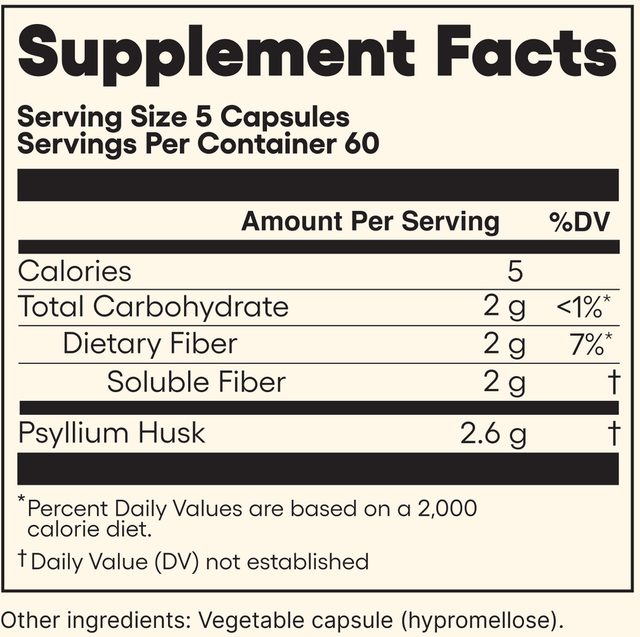
Label read Oct 10, 2026
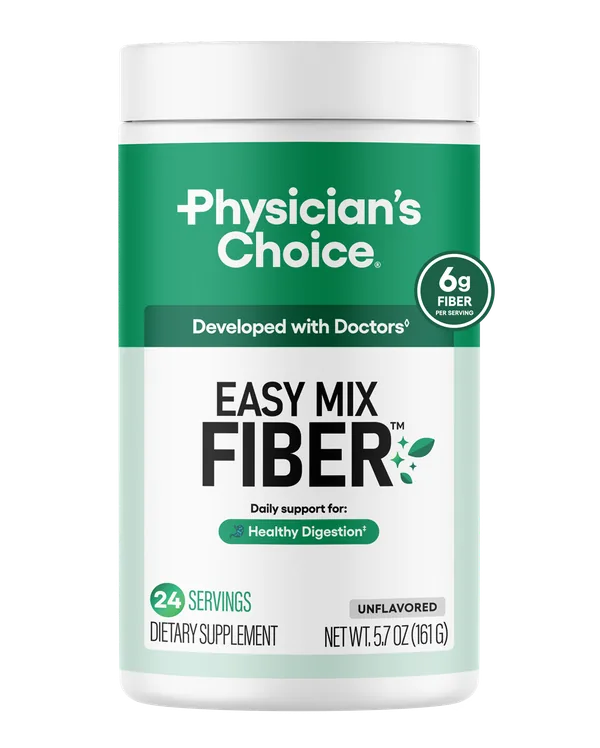
See the label
How we reported this
- Reader questions
- Of 1,031 public Reddit posts from 228 communities, Sep 5 to Oct 5, 2026, 21 mentioned psyllium. Their questions ran from how to take it to how much to take.
- Search question
- "Psyllium fiber supplement," with its neighbors on psyllium husk capsules and powder, as people type them into search and AI answer engines.
- Label facts
- Two panels, Psyllium Husk Fiber and Easy Mix Fiber, copied line by line from the label images on physicianschoice.com on Oct 10, 2026.
- Sources
- Eight public sources, each fetched and read on Oct 10, 2026: five FDA documents, two MedlinePlus pages and one trial report. Drug rules are labeled as drug rules.
- House wording
- Four lines come from Physician's Choice word for word: regularity, daily fiber, fluid, and when to see a doctor.
Quick answers
Is psyllium a laxative or a fiber supplement?
It can be either, and the label tells you which. Sold as a drug, psyllium is a bulk-forming laxative under FDA's monograph and carries a Drug Facts label. Sold as a dietary supplement, it carries a Supplement Facts panel, and FDA says the Drug Facts labeling requirements do not apply to it.
How much psyllium is in one dose?
It depends on the product. For psyllium drug products, FDA's monograph sets 2.5 to 7.5 grams per dose, up to 30 grams a day, for adults and children 12 and over. Physician's Choice Psyllium Husk Fiber, a supplement, lists 2.6 g of psyllium husk per 5-capsule serving; a supplement label sets its own serving, not a drug dose.
Do psyllium capsules need as much water as the powder?
Yes. FDA's rule for dry psyllium drug products names capsules next to powders, granules, tablets and wafers, and calls for at least 8 ounces (a full glass) of fluid. MedlinePlus gives the same 8 ounces (240 milliliters) for psyllium. Never swallow the capsules dry.
How many psyllium capsules make a serving?
As many as the label says; one capsule holds a fraction of a gram, so a serving takes several. On the Physician's Choice Psyllium Husk Fiber panel a serving is 5 capsules, holding 2.6 g of psyllium husk and 2 g of fiber, or about 0.52 g of husk per capsule by our arithmetic.
Who should not take psyllium?
FDA's required warning says not to take it if you have difficulty in swallowing. MedlinePlus says to tell your doctor first if you are allergic to psyllium, have had intestinal blockage, or are pregnant or breastfeeding. If constipation does not get better with changes to what you eat and drink, talk to your doctor.
Sources
- MedlinePlus Drug Information (American Society of Health-System Pharmacists). Psyllium. Last revised Jun 20, 2024. medlineplus.gov/druginfo/meds/a601104.html
- US Food and Drug Administration. OTC Monograph M007: Laxative Drug Products for Over-the-Counter Human Use. Posted May 2, 2023. accessdata.fda.gov (PDF)
- US Food and Drug Administration. 21 CFR 201.319, Water-soluble gums, hydrophilic gums, and hydrophilic mucilloids as active ingredients; required warnings and directions. eCFR, current as of Oct 7, 2026. ecfr.gov
- US Food and Drug Administration. The Over-the-Counter Drug Facts Label. Content current as of Sep 2, 2026. fda.gov
- US Food and Drug Administration. Questions and Answers on Dietary Supplements. Content current as of Aug 27, 2026. fda.gov
- US Food and Drug Administration. Questions and Answers on Dietary Fiber. Content current as of Jul 25, 2024. fda.gov
- Reid JESJ, et al. A randomised, placebo-controlled trial in healthy humans of modified cellulose or psyllium evaluating the role of gelation in altering colonic gas production during inulin co-administration. Food and Function. Published Feb 4, 2026. pmc.ncbi.nlm.nih.gov/articles/PMC12869852
- MedlinePlus Medical Encyclopedia. Fiber. Review date Jul 22, 2026. medlineplus.gov/ency/article/002470.htm
- Physician's Choice product labels: Psyllium Husk Fiber (label image), Easy Mix Fiber. Read Oct 10, 2026. Fiber Gummies is named only in the company's regularity line. Lines quoted from Physician's Choice are reproduced exactly as the company wrote them.