The answer
The one whose fiber type and grams fit you. Psyllium is soluble, gel-forming and not fermented, a 2015 review says; inulin and wheat dextrin dissolve without gelling and ferment quickly. Then read grams per serving: Easy Mix Fiber lists 6 g, Fiber Gummies 5 g, Psyllium Husk Fiber 2 g. Adults get 25 to 38 grams of fiber per day, though exact targets depend on age and sex.
Key facts
- 4 traits sort fiber supplements: solubility, viscosity, gel formation and degree of fermentation. [American Journal of Lifestyle Medicine, 2020]
- Psyllium is soluble, viscous, gel-forming and not fermented; inulin and wheat dextrin are soluble, nonviscous and readily fermented. [Nutrition Today, 2015]
- 25 g and 38 g a day are the Institute of Medicine figures for women and men, about 14 g per 1,000 calories eaten. [American Journal of Lifestyle Medicine, 2020]
- 28 g is FDA's Daily Value for dietary fiber, the base for the %DV on a fiber label. [FDA]
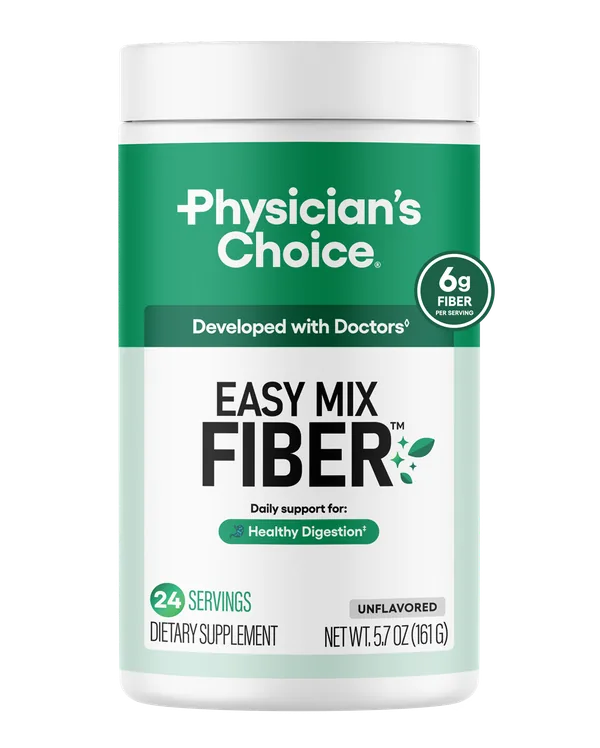
- 6 g (21% DV), 5 g (18% DV) and 2 g of fiber per serving: Easy Mix Fiber, Fiber Gummies and Psyllium Husk Fiber. [Physician's Choice labels, checked Oct 10, 2026]
What should you compare in a fiber supplement? Four traits
Its physical behavior, more than its brand or form. Four traits decide what a fiber does once you swallow it.
A 2020 pharmacist's guide in the American Journal of Lifestyle Medicine names them: solubility, viscosity, gel formation and degree of fermentation. "Soluble fiber dissolves in water while insoluble fiber passes through the digestive system relatively intact," it explains. Some soluble fibers thicken and gel when wet; others dissolve and stay thin.
Fermentation is the trait you feel. Gut bacteria break down some fibers in the colon, and a 2015 review in Nutrition Today lists gas among the by-products of that process. A fiber that ferments quickly is gone from the stool once it is used up; one that resists fermentation keeps holding water as it moves through.
Two cautions from the same sources. Fiber supplements are isolated fibers, usually from a single source, and they cannot be presumed to bring every benefit tied to fiber-rich foods. And Mayo Clinic notes that supplements lack the vitamins, minerals and other nutrients that fiber-rich foods carry.
Types of fiber supplements compared: psyllium, methylcellulose, wheat dextrin, inulin and more
Most supplement fibers are soluble. They split on two questions: does it gel, and do gut bacteria ferment it?
Seven supplement fibers, by type
| Fiber type | Soluble or insoluble | Gel or thicken in water? | Fermented by gut bacteria? | Source |
|---|---|---|---|---|
| Psyllium husk | Soluble | Yes, viscous and gel-forming | No, in people; the review notes lab models have reported otherwise | McRorie 2015; White 2020 |
| Methylcellulose | Soluble: FDA lists it under water-soluble and hydrophilic gums | Viscous, but not gel-forming (White 2020) | Poorly, in lab models of colon microbes | 21 CFR 201.319; White 2020; Reid 2026 |
| Wheat dextrin | Soluble | No, nonviscous | Yes, readily | McRorie 2015; Slavin 2013 |
| Inulin, including from chicory root | Soluble | No, nonviscous | Yes, readily | McRorie 2015; Slavin 2013 |
| Soluble corn fiber | Soluble | Not tested in the trial we read | Yes: at 20 g a day, adults reported more flatulence than on a low-fiber control | Timm 2013 (soluble corn fiber is the first fiber on the Easy Mix Fiber label) |
| Guar gum | Soluble | Raw guar gum gels; partially hydrolyzed guar gum is not viscous | Yes | McRorie 2015; Slavin 2013 |
| Pectin | Soluble (some pectins insoluble) | Yes, viscous | Yes | Slavin 2013 |
Sources: McRorie, Nutrition Today 2015 (parts 1 and 2); White, American Journal of Lifestyle Medicine 2020; Slavin, Nutrients 2013, table 1; Reid, Food and Function 2026; Timm, Journal of Nutrition 2013; FDA, 21 CFR 201.319. Full list at the end.
How much gas each type makes, and what the studies of psyllium with inulin measured, is in our guide to fiber that doesn't cause gas. This page sticks to type and grams.
Psyllium vs other fiber supplements: what is the difference?
Psyllium is the one fiber in the table that both forms a gel and resists fermentation, in the reviews we read.
"psyllium is not fermented in the gut and retains its water-holding gelled structure throughout the large bowel."
McRorie, Nutrition Today, 2015, part 2
The same author adds that lab tests have often reported psyllium as fermentable, and calls that a discrepancy between in vitro data and human experience. He works for a company that markets a fiber product, as the paper discloses, so the independent 2020 pharmacist's guide is worth reading beside it; it also calls psyllium nonfermented, soluble, viscous and gel-forming.
Methylcellulose sits close by. The 2020 guide calls it viscous but non-gel-forming, and a 2026 trial report in Food and Function notes it "has been shown to be poorly fermented using in vitro models of the human colonic microbiota." Wheat dextrin and inulin sit at the other end: they dissolve, stay thin and ferment fast.
How psyllium's drug and supplement labels differ, and how many grams a capsule holds, is in our guide to psyllium fiber supplements.
How many grams of fiber are in a fiber supplement? Three labels compared
Between 2 g and 6 g a serving on the three Physician's Choice labels below. Read the Dietary Fiber line, not the size of the scoop or the number of pieces.
Three fiber supplements, as printed on the label
| Product | Form and serving | Fiber per serving | Fiber source as printed | Type, per the table above |
|---|---|---|---|---|
| Easy Mix Fiber | Powder: 1 heaping spoonful (6.7 g); about 24 servings | 6 g, 21% DV, all soluble | Soluble corn fiber and guar fiber | Soluble and fermented; the label does not say which guar |
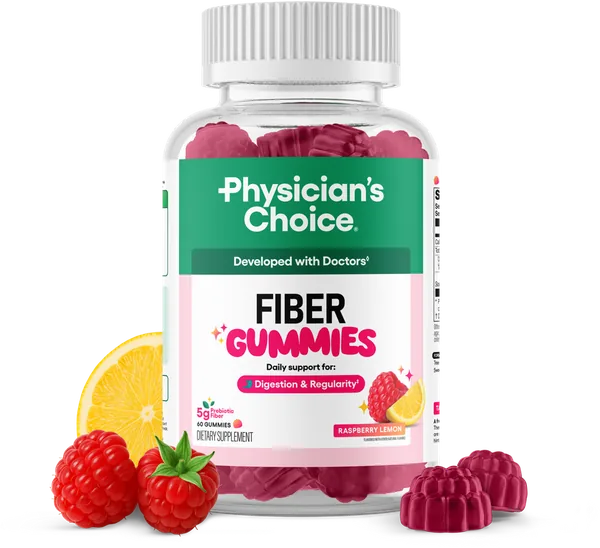
| Fiber Gummies | Gummy: 2 gummies; 30 servings | 5 g, 18% DV | Chicory root fiber; pectin is also on the ingredient list | Whether the chicory root fiber is inulin is being confirmed with Physician's Choice |
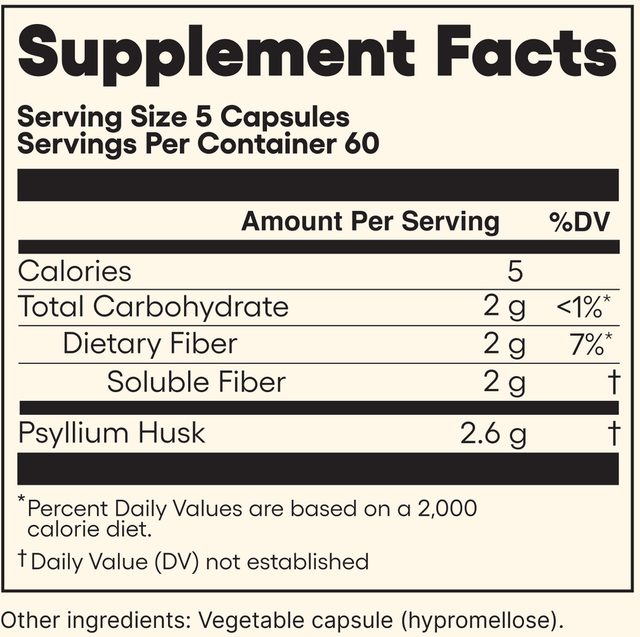
| Psyllium Husk Fiber | Capsule: 5 capsules; 60 servings | 2 g, all soluble | 2.6 g psyllium husk | Soluble, gel-forming, not fermented |
Source: Physician's Choice Supplement Facts panels, checked against the label images on physicianschoice.com on Oct 10, 2026. %DV is printed on the label and uses FDA's 28 g Daily Value.
The gummy panel adds a few lines a powder or capsule may not need: under 1 g total sugars, 0 g added sugars and 15 calories per 2 gummies, vegan and formulated without gelatin, artificial sweeteners or flavors, and a printed note that it is third-party tested and made in the USA in a cGMP certified facility. Those lines matter if you are counting sugar or avoid animal gelatin. How to read the sugar lines, and where a sweetener would appear, is in our guide to fiber gummies without the candy.
How do you get 25 grams of fiber a day?
From food first, with a supplement covering what is left. Adults get 25 to 38 grams of fiber per day, though exact targets depend on age and sex.
Those numbers trace back to the Institute of Medicine, which the 2020 guide quotes as about 25 g a day for women and 38 g for men, or 14 g for every 1,000 calories eaten. The 2015 review puts the average US intake at about 15 g a day, so most people start well short.
Food closes most of that gap. Whole grains, beans and lentils, fruits, vegetables and nuts are the sources on our fiber from food list. A supplement serving then adds a known amount: 2 g to 6 g on the three labels above. Count the grams you actually eat for a few days before you pick a dose.
Is it safe to take a fiber supplement every day?
For most people, yes. Mayo Clinic puts it plainly: "Taking fiber supplements every day seems to be safe."
Its advice comes with conditions. Fiber supplements can cause belly bloating and gas, at least at first, so start with small amounts, do not take more than the label says, and drink plenty of fluids every day. Mayo also says to ask whether a fiber supplement will affect any medicines you take. Physician's Choice gives the same fluid advice: "Drink plenty of water and other liquids when you take a fiber supplement to help keep things moving."
What time of day to take it, and how far to keep it from medicines, are answered in our guide on when to take a fiber supplement.
Where Physician's Choice fits
Physician's Choice, the publisher of this site, makes the three products read above, one in each form: a powder, a gummy and a capsule. Physician's Choice Fiber Gummies, Easy Mix Fiber and Psyllium Husk Fiber are made to support regularity and help with occasional constipation.* Which one fits depends on the form you will keep taking and on the fiber type in the table above. If you want a probiotic in the same product, our guide to fiber supplements with probiotics in them shows what to check.
See the label
Label read Oct 10, 2026
Label read Oct 10, 2026
Being confirmed with Physician's Choice: whether the chicory root fiber in Fiber Gummies is inulin, and which soluble corn fiber and guar fiber Easy Mix Fiber uses.
How we reported this
- Reader questions
- Of 1,031 public Reddit posts from 228 communities, Sep 5 to Oct 5, 2026, 143 were about fiber, and five asked whether they were getting enough fiber and what kind to add.
- Search question
- "What's a good fiber supplement," with its neighbors on fiber types, psyllium and daily grams, as people type them into search and AI answer engines.
- Label facts
- Easy Mix Fiber, Fiber Gummies and Psyllium Husk Fiber panels, checked against the label images on physicianschoice.com on Oct 10, 2026.
- Sources
- Nine public sources, each fetched and read on Oct 10, 2026: five peer-reviewed papers, one trial record, Mayo Clinic and two FDA documents.
- House wording
- The daily target, fluid, regularity and doctor lines credited to Physician's Choice are the company's approved wording.
Quick answers
Is it safe to take fiber pills every day?
Mayo Clinic says taking fiber supplements every day seems to be safe. It advises starting with small amounts, not taking more than the label says, drinking plenty of fluids every day, and asking whether a fiber supplement will affect any medicines you take. Bloating and gas can come at first.
How do I get 25 grams of fiber a day?
Mostly from food, then a supplement for the gap. Adults get 25 to 38 grams of fiber per day, though exact targets depend on age and sex, while a 2015 review puts the average US intake at about 15 g. One serving on the three labels on this page adds 2 to 6 g.
Which type of fiber supplement makes the least gas?
By type, the ones gut bacteria do not ferment. A 2015 review classes psyllium as not fermented, and a 2026 trial report says methylcellulose is poorly fermented in lab models, while inulin and wheat dextrin are fermented quickly. Our guide to fiber that does not cause gas covers what the studies measured.
What does the % Daily Value mean on a fiber supplement label?
It compares one serving with FDA's Daily Value for dietary fiber, which is 28 grams. That is why the Easy Mix Fiber label prints 6 g as 21% DV and the Fiber Gummies label prints 5 g as 18% DV.
Is a psyllium capsule the same as psyllium husk?
It is psyllium husk in a capsule, but read two numbers. The Physician's Choice Psyllium Husk Fiber label lists 2.6 g of psyllium husk per 5 capsules and 2 g of dietary fiber from it. The fiber line, not the husk weight, is the number to count toward your day.
Sources
- White N. A guide to recommending fiber supplements for self-care. American Journal of Lifestyle Medicine. Published Aug 22, 2020. pmc.ncbi.nlm.nih.gov/articles/PMC7566180
- McRorie JW Jr. Evidence-based approach to fiber supplements and clinically meaningful health benefits, part 1. Nutrition Today. 2015. pmc.ncbi.nlm.nih.gov/articles/PMC4415962
- McRorie JW Jr. Evidence-based approach to fiber supplements and clinically meaningful health benefits, part 2. Nutrition Today. 2015. pmc.ncbi.nlm.nih.gov/articles/PMC4415970
- Slavin J. Fiber and prebiotics: mechanisms and health benefits. Nutrients. 2013. pmc.ncbi.nlm.nih.gov/articles/PMC3705355
- Reid JESJ, et al. A randomised, placebo-controlled trial in healthy humans of modified cellulose or psyllium evaluating the role of gelation in altering colonic gas production during inulin co-administration. Food and Function. Published Feb 4, 2026. pmc.ncbi.nlm.nih.gov/articles/PMC12869852
- Timm DA, et al. Polydextrose and soluble corn fiber increase five-day fecal wet weight in healthy men and women. Journal of Nutrition. 2013. pubmed.ncbi.nlm.nih.gov/23427334
- Mayo Clinic Staff. Fiber supplements: Safe to take every day? Dec 19, 2025. mayoclinic.org
- US Food and Drug Administration. Daily Value on the Nutrition and Supplement Facts labels. Content current as of Mar 5, 2024. fda.gov
- US Food and Drug Administration. 21 CFR 201.319, Water-soluble gums, hydrophilic gums, and hydrophilic mucilloids as active ingredients. Code of Federal Regulations, 2024 edition. govinfo.gov (PDF)
- Physician's Choice product labels: Easy Mix Fiber, Fiber Gummies (label image), Psyllium Husk Fiber (label image). Checked Oct 10, 2026. Daily target, fluid, regularity and doctor lines credited to Physician's Choice are company wording.