The answer
Psyllium husk is the outer coat of the seed of Plantago ovata, a soluble fiber that soaks up water and turns to gel. About 55% of the husk is a gel-forming part that gut bacteria barely ferment, so it reaches the stool as gel and adds moisture. MedlinePlus calls for at least 8 ounces of liquid with each dose. A Cleveland Clinic dietitian calls it gluten-free.
Psyllium husk in five lines
- The husk: psyllium husk is the outer covering of the psyllium seed, from the plant Plantago ovata. [Cleveland Clinic; Fischer et al., 2004]
- The gel: the part of the husk that gels is a neutral arabinoxylan, 74.6% xylose and 22.6% arabinose on a molar basis. [Fischer et al., 2004]
- About 55% of the husk is that gel-forming fraction, which is poorly fermented and increases stool moisture. [Marlett and Fischer, 2003]
- 8 ounces and 2 hours: MedlinePlus calls for at least 8 ounces (240 milliliters) of liquid with psyllium, and Cleveland Clinic's drug sheet for at least 2 hours between psyllium and other medicines. [MedlinePlus; Cleveland Clinic]
- Gluten: psyllium is not wheat, rye or barley, the three gluten grains in FDA's labeling rule, and a Cleveland Clinic dietitian says it is gluten-free. [FDA; Cleveland Clinic]
What is psyllium husk made of?
Mostly one carbohydrate that turns to gel in water. The husk is the outer covering of the psyllium seed. When researchers took it apart, about 55% of it was a gel-forming fraction built from two sugars, xylose and arabinose. A smaller share ferments quickly, and another part does not ferment at all.12
Cleveland Clinic puts the anatomy in one line: "psyllium husk is the outer covering of psyllium."4 The chemistry comes from a University of Wisconsin team. In 2004 it described the active, gel-forming part as "a neutral arabinoxylan (arabinose 22.6%, xylose 74.6%, molar basis; only traces of other sugars)", and found it highly branched.2 A year earlier, two of the same researchers had split the husk into three fractions and tested what each one does.1
Psyllium husk, part by part
| Part or property | What the source reports | Source |
|---|---|---|
| The husk | The outer covering of the psyllium seed | Cleveland Clinic4 |
| Gel-forming fraction | About 55% of the husk; poorly fermented; the component that increases stool moisture | Marlett and Fischer, 20031 |
| Fast-fermenting fraction | Under 15% of the husk; viscous, but rapidly fermented | Marlett and Fischer, 20031 |
| Alkali-insoluble fraction | Not fermented | Marlett and Fischer, 20031 |
| Sugars in the gel | Xylose 74.6% and arabinose 22.6% (molar basis), traces of other sugars; highly branched | Fischer et al., 20042 |
| Kind of fiber | Soluble: it attracts water and turns to gel during digestion | MedlinePlus3 |
| On a label | Named by FDA as an isolated fiber that meets its definition of dietary fiber | FDA7 |
Sources: Marlett and Fischer, Proceedings of the Nutrition Society, 2003; Fischer et al., Carbohydrate Research, 2004; Cleveland Clinic; MedlinePlus; FDA. All read on Oct 16, 2026. The fraction shares are the 2003 paper's own figures.
Where the plant is grown, and the names psyllium goes by on drug labels, are in our guide to psyllium fiber supplements.
How does psyllium husk work in the gut?
It holds water. Soluble fiber "attracts water and turns to gel during digestion", MedlinePlus says, and psyllium's gel is poorly fermented, so much of it survives the trip through the colon. In a controlled diet study, researchers recovered a gel from people's stools while they ate psyllium husk, and found none when only the control diet was eaten.31
Marlett and Fischer contrast psyllium's gel with arabinoxylans in cereal grains "that are extensively fermented," and conclude that the husk has a structural feature, "as yet unidentified, that hinders its fermentation by typical colonic microflora."1 The resistance is not total. "Although psyllium is resistant to fermentation, gut bacteria can ferment a small amount of psyllium," Cleveland Clinic dietitian Julia Zumpano says.4
"gel-forming fraction B, which is about 55% of PSH, is poorly fermented and is the component that increases stool moisture"
Marlett and Fischer, Proceedings of the Nutrition Society, 2003 (PSH: psyllium seed husk)
The result shows up in the stool. A Cleveland Clinic article says psyllium "works by increasing the weight of your stool, which helps trigger a bowel movement."4 How that gel compares with inulin, wheat dextrin and other supplement fibers is set out in what is a good fiber supplement?, and what studies of gas measured is in fiber that doesn't cause gas.
Is psyllium husk soluble or insoluble fiber?
Soluble. MedlinePlus lists psyllium, which it calls "a common fiber supplement", among the sources of soluble fiber, the kind that forms a gel in digestion. Insoluble fiber, from foods such as wheat bran, vegetables and whole grains, is the other kind, and MedlinePlus says it "adds bulk to the stool".3
On a label, psyllium husk counts as fiber. FDA names "Psyllium husk" among the isolated fibers that meet its definition of dietary fiber, so the husk in a supplement shows up in the Dietary Fiber line of the panel.7 Grams of husk and grams of fiber are two separate lines on a panel; our psyllium guide reads them one by one.
Is psyllium safe?
Yes, by the sources' account, as long as it goes down with plenty of liquid. Psyllium husk "is considered very safe," Cleveland Clinic dietitian Julia Zumpano says. The risks the drug references flag are practical ones: choking when it is swallowed without enough fluid, allergic reactions, and getting in the way of some medicines, so both set rules on liquid and spacing.456
Taking psyllium safely: what two drug references say
| Topic | MedlinePlus drug information | Cleveland Clinic drug sheet |
|---|---|---|
| Liquid with each dose | "you must drink at least 8 ounces (240 milliliters) of liquid when you take it"6 | Mix it into "a full glass (240 mL) of water or other cool drink"5 |
| Other medicines | Keep digoxin, salicylates such as aspirin, and nitrofurantoin 3 hours away from psyllium6 | "Take this product at least 2 hours before or after other medications."5 |
| Call or report right away for | Difficulty breathing, stomach pain, difficulty swallowing, skin rash, itching, nausea or vomiting6 | Signs of an allergic reaction (rash, itching, hives, swelling of the face, lips, tongue or throat) or of choking (chest pain, trouble swallowing or breathing, vomiting)5 |
| Milder effects | Not listed as a separate group | Bloating, diarrhea, gas, nausea, stomach pain; report them if they continue or bother you5 |
| Tell your doctor first about | An allergy to psyllium; rectal bleeding, intestinal blockage or difficulty swallowing, among other conditions it lists; pregnancy or breastfeeding6 | Trouble swallowing; phenylketonuria (PKU); a sudden shift in bowel habits lasting over 2 weeks; pregnancy or breastfeeding5 |
| The powder itself | "It can cause allergic reactions when accidentally inhaled."6 | Not stated |
Sources: MedlinePlus Drug Information, Psyllium; Cleveland Clinic, Psyllium Powder for Suspension. Both read on Oct 16, 2026, and both written for psyllium sold as a drug. Brand names in either source are left out.
The two references part ways on spacing: MedlinePlus names three medicines to keep 3 hours apart from psyllium, while Cleveland Clinic's sheet sets 2 hours around any medicine. Ask a pharmacist which rule fits what you take. A Cleveland Clinic article adds diarrhea, constipation, nausea, gas, bloating and stomach pain or cramping as side effects people may notice, and Zumpano advises caution for anyone with a sensitive digestive system.4
For any fiber supplement, Physician's Choice gives one line: "Drink plenty of water and other liquids when you take a fiber supplement to help keep things moving." The full choking warning FDA requires on psyllium drug labels is quoted in our psyllium guide.
Is psyllium husk gluten-free?
The plant is. Psyllium comes from Plantago ovata, which is not one of the gluten grains FDA's labeling rule names, wheat, rye and barley, and Cleveland Clinic dietitian Julia Zumpano answers the question with a plain yes. A packaged product is a separate matter: it can say "gluten-free" only if it meets FDA's rule, which caps any gluten at less than 20 parts per million.84
Zumpano's own words: "It can be used as a gum in gluten-free baked goods."4 FDA defines a "gluten-containing grain" as wheat, rye or barley, or a crossbred hybrid of them such as triticale, and allows the claim on a food with no such ingredient, or one that inherently contains no gluten, as long as any gluten it cannot avoid stays below 20 ppm.8 The rule applies to the food that carries the claim, so a flavored or mixed psyllium product is judged on everything in it, not on the husk alone.
How much psyllium husk per day?
As much as the label on your product says, reached slowly. Zumpano's advice for a first dose: "Start at a small dose, about 1 teaspoon, and increase slowly". For psyllium sold as a laxative drug, FDA's monograph sets the adult amount at up to 30 grams a day, taken in doses of 2.5 to 7.5 grams.49
Grams of husk per serving on supplement labels, and how to take powders, capsules and wafers, are covered in psyllium fiber supplements: grams per serving and how to take it. For all fiber combined, Physician's Choice, the publisher of this site, gives one line: Adults get 25 to 38 grams of fiber per day, though exact targets depend on age and sex. Foods that bring fiber, and the ones tried in constipation trials, are in foods that help constipation.
Where Physician's Choice fits
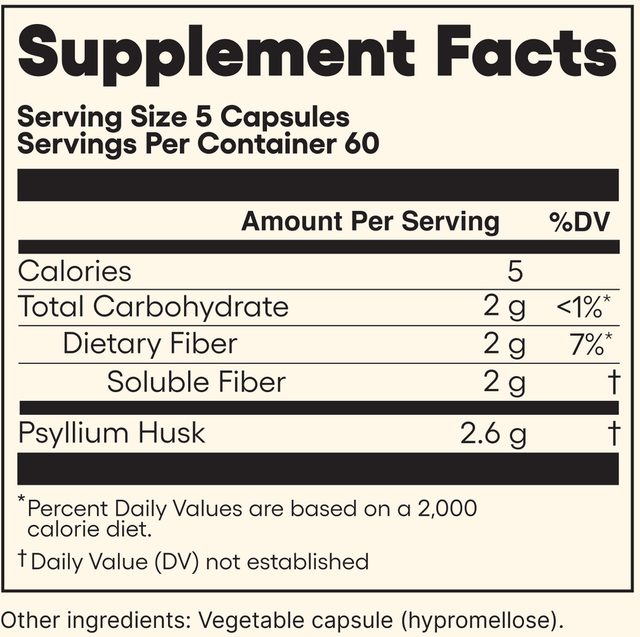
The publisher of this site sells psyllium as capsules: the Physician's Choice Psyllium Husk Fiber panel lists 2.6 g of psyllium husk and 2 g of dietary fiber, all soluble, in a 5-capsule serving.
No source cited here tested it.
The short version
Psyllium husk is the seed coat of Plantago ovata, and more than half of it is a gel that gut bacteria barely ferment, which is why it holds water in the stool. A Cleveland Clinic dietitian calls it very safe, the drug references add a full glass of liquid and space from other medicines, and the plant is not a gluten grain.
How we reported this
- Reader questions
- In a pull of 1,145 public Reddit posts (250 communities, Sep 12 to Oct 12, 2026), 20 mentioned psyllium. One asked whether it gets in the way of absorbing nutrients.
- Search question
- "What is psyllium husk?" with its neighbors, "is psyllium safe," "is psyllium husk gluten free" and "how much psyllium husk per day," plus the follow-up AI assistants run on how it works and its safety.
- Label facts
- The Psyllium Husk Fiber panel, as its label image on physicianschoice.com showed it on Oct 16, 2026.
- Sources
- Nine public sources, each fetched and read on Oct 16, 2026: two laboratory papers, two MedlinePlus pages, two Cleveland Clinic pages, FDA's dietary fiber list, its gluten-free rule and its laxative monograph. Brand names in the drug sources are left out.
- House wording
- Two lines come from Physician's Choice word for word: fluid and daily fiber. One more, on when to talk to your doctor, sits in the box beside this answer.
Psyllium questions, answered
What is psyllium husk made from?
The outer covering of the seed of the psyllium plant, Plantago ovata. About 55% of the husk is a gel-forming fraction, a highly branched carbohydrate built mostly from the sugars xylose and arabinose, according to two laboratory papers on the husk from 2003 and 2004.
Is psyllium husk soluble or insoluble fiber?
Soluble. MedlinePlus lists psyllium among the sources of soluble fiber, which attracts water and turns to gel during digestion. FDA counts psyllium husk as dietary fiber on Nutrition and Supplement Facts labels, so it adds to the Dietary Fiber line of a panel.
Is psyllium husk gluten-free?
The plant is not wheat, rye or barley, the gluten grains in FDA's labeling rule, and a Cleveland Clinic dietitian says psyllium husk is gluten-free. A packaged product may carry a gluten-free claim only if it meets FDA's rule, including less than 20 parts per million of gluten.
How long should you wait between psyllium and other medicines?
It depends on the reference. Cleveland Clinic's drug sheet says to take psyllium at least 2 hours before or after other medications. MedlinePlus names digoxin, salicylates such as aspirin, and nitrofurantoin, and says not to take them within 3 hours of psyllium. A pharmacist can tell you which applies.
Does psyllium husk cause gas?
It can. A Cleveland Clinic article lists gas and bloating among possible side effects, and its drug sheet counts them as milder effects. Psyllium's gel-forming part is poorly fermented, a 2003 paper reports, and starting with a small amount, about 1 teaspoon, is what Cleveland Clinic's dietitian suggests.
Sources
- Marlett JA, Fischer MH. The active fraction of psyllium seed husk. Proceedings of the Nutrition Society. 2003;62(1):207-9. pubmed.ncbi.nlm.nih.gov/12749348
- Fischer MH, Yu N, Gray GR, Ralph J, Anderson L, Marlett JA. The gel-forming polysaccharide of psyllium husk (Plantago ovata Forsk). Carbohydrate Research. 2004;339(11):2009-17. pubmed.ncbi.nlm.nih.gov/15261594
- MedlinePlus (National Library of Medicine). Soluble vs. insoluble fiber. Review date Aug 25, 2026. medlineplus.gov
- Cleveland Clinic Health Essentials. Should you be using psyllium husk? Interview with registered dietitian Julia Zumpano, RD, LD. Published Dec 11, 2023. health.clevelandclinic.org
- Cleveland Clinic Health Library. Psyllium Powder for Suspension (drug sheet). my.clevelandclinic.org
- MedlinePlus Drug Information. Psyllium. Last revised Jun 20, 2024. medlineplus.gov
- US Food and Drug Administration. Questions and Answers on Dietary Fiber. Content current as of Jul 25, 2024. fda.gov
- US Food and Drug Administration. 21 CFR 101.91, Gluten-free labeling of food. eCFR, up to date as of Oct 15, 2026. ecfr.gov
- US Food and Drug Administration. OTC Monograph M007: Laxative Drug Products for Over-the-Counter Human Use. Posted May 2, 2023. accessdata.fda.gov (PDF)
- Physician's Choice product label: Psyllium Husk Fiber (label image on physicianschoice.com). Read Oct 16, 2026. Physician's Choice lines on this page appear word for word.