The answer
A soluble fiber supplement carries fiber that dissolves in water. Some soluble fibers thicken into a gel, as psyllium does; others stay thin and are fermented by gut bacteria, as inulin from chicory root is. This page covers six sold in supplements: psyllium, guar gum, methylcellulose, inulin, wheat dextrin and soluble corn fiber, with what a study measured for each.
In five lines
- Dissolves in water: soluble fiber draws in water and becomes a gel as food is digested, which slows digestion, MedlinePlus says; the insoluble kind bulks up stool instead. [MedlinePlus, 2026]
- Gel or ferment: Harvard's Nutrition Source describes some fibers as viscous, with a gel-like quality, and others as fermentable, food for the gut bacteria that break them down. [Harvard T.H. Chan School of Public Health]
- Psyllium: in a 2022 review of 16 trials in adults with constipation, psyllium raised stool frequency and improved stool consistency and straining; inulin-type fructans modestly softened stool consistency. [van der Schoot et al., 2022]
- 1, 2 or 4 g a day: every daily dose of methylcellulose raised stool frequency, stool water content and fecal solids in 59 adults with long-term constipation, in a 1988 trial. [Hamilton et al., 1988]
- 6 g and 2 g, all soluble: the fiber per serving printed on Easy Mix Fiber (a heaping spoonful) and Psyllium Husk Fiber (5 capsules). [Physician's Choice labels, read Oct 26, 2026]
What is soluble fiber?
Fiber that dissolves in water. MedlinePlus describes soluble fiber as the kind that draws in water and becomes a gel as food is digested, which slows digestion, and it names oat bran, barley, nuts, seeds, beans, lentils and peas, some fruits and vegetables, and psyllium as sources. Harvard's Nutrition Source adds oatmeal, chia seeds, apples and blueberries.12
Fiber is the part of plant food your body does not digest. Harvard sums up the National Academy of Medicine's definition as two kinds: dietary fiber that occurs naturally in plants, and functional fiber that is extracted from plants or made, with a health effect shown in people. A soluble fiber supplement carries the second kind, an isolated fiber such as psyllium husk or inulin, counted in grams on the Dietary Fiber line of its panel.25
Soluble vs insoluble fiber: what is the difference?
Soluble fiber dissolves in water; insoluble fiber does not. In the gut, soluble fiber forms a gel or feeds bacteria, while insoluble fiber bulks up stool and, by MedlinePlus's account, seems to move food through the stomach and intestines faster. The two come from different foods, as the table shows.21
Soluble and insoluble fiber, side by side
| Trait | Soluble fiber | Insoluble fiber |
|---|---|---|
| In water | Dissolves; some kinds thicken into a gel | Does not dissolve |
| In the gut | Turns to a gel that slows digestion; fermentable kinds feed gut bacteria | Adds bulk to stool and appears to speed food through |
| Foods | Oat bran, oatmeal, barley, beans, lentils, peas, nuts, chia seeds, apples, blueberries | Wheat bran, whole wheat products, whole grains, quinoa, brown rice, leafy greens, fruits with edible skins |
| Fiber types the sources name | Psyllium, guar gum, inulin, pectins, beta-glucans | Cellulose, hemicellulose, lignins |
Sources: MedlinePlus, Soluble vs. insoluble fiber, review date Aug 25, 2026; Harvard T.H. Chan School of Public Health, The Nutrition Source, Fiber, last reviewed April 2022. Both read on Oct 26, 2026.
Both kinds end up helping stool along, by different routes. Some soluble fibers bind water into a gel that softens and bulks stool, Harvard explains, while insoluble fibers mildly irritate the lining of the gut, which brings out water and mucus that move stool along.2
Gel-forming or fermentable: what does soluble fiber do in the gut?
It gels, it ferments, or it does some of each. Viscous fibers thicken in water into thick solutions or gels, and fermentable fibers are broken down by the bacteria of the large intestine, the Linus Pauling Institute at Oregon State University explains. It places psyllium among the gel-forming fibers that resist fermentation, and inulin and wheat dextrin among the fibers that dissolve without thickening and ferment readily.3
Fermentation turns fiber into short-chain fatty acids, acetate, propionate and butyrate, along with gases, and butyrate is the preferred fuel of the cells that line the colon. Fibers that ferment and stimulate the growth or activity of helpful gut bacteria are called prebiotic fibers, and the institute classes inulin and oligofructose, extracted from chicory root, as prebiotics for their ability to stimulate Bifidobacteria in the colon.3
Gel-forming fibers keep their water-holding gel through the large intestine because they resist fermentation, the institute adds, and Harvard describes psyllium as a fiber that holds onto water and softens and bulks stools.32 Each fiber's gel and fermentation profile, trait by trait, is in what is a good fiber supplement?, and how much gas each made in lab tests is in fiber that doesn't cause gas.
Which fiber supplements are soluble?
This page covers six: psyllium husk, guar gum (including partially hydrolyzed guar gum), methylcellulose, inulin from chicory root, wheat dextrin and soluble corn fiber. FDA's rule on water-soluble gums sold as drugs names psyllium, guar gum and methylcellulose; the Linus Pauling Institute classes inulin and wheat dextrin as soluble; and soluble corn fiber carries the word in its name.43
On a supplement panel, these fibers count toward the Dietary Fiber line. FDA's list of isolated fibers that count under its dietary fiber definition includes psyllium husk and guar gum, and FDA lets makers count inulin-type fructans and resistant maltodextrin or dextrin while it moves to add them.5 Guar gum comes in two forms: raw guar gum thickens water, and the institute notes that the thickening is lost when guar is partially hydrolyzed into PHGG.3 What the psyllium husk itself is made of is in what is psyllium husk?
What was each soluble fiber supplement studied for?
Mostly bowel habits: how often people went, stool form and stool weight, in adults with constipation, long-term care residents or healthy volunteers. The wheat dextrin work here comes from a lab model of the colon. Each row gives what the study measured, at the study's own daily amount.67891011
Six soluble fibers and what a study measured
| Fiber | Who was studied | Daily amount | What the study measured | Source |
|---|---|---|---|---|
| Psyllium | Adults with constipation, in the trials a 2022 review pooled (16 trials of fiber, 1,251 adults) | Set by each trial | Psyllium raised stool frequency and improved stool consistency and straining | van der Schoot et al., 2022 |
| Methylcellulose | 59 adults with long-term constipation, after a first phase in 50 healthy adults | 1, 2 or 4 g | Every dose raised stool frequency, stool water content and fecal solids | Hamilton et al., 1988 |
| Partially hydrolyzed guar gum | 52 long-term care residents with long-term constipation, average age 84 | 5 g in 200 ml of water, for 4 weeks | Residents used laxatives less often than the control group in weeks 3 and 4 | Chan et al., 2022 |
| Inulin from chicory root | 44 adults with constipation | 12 g, for 4 weeks | A median of 4.0 stools a week, against 3.0 on placebo | Micka et al., 2017 |
| Soluble corn fiber | 36 healthy men and women | 20 g, for 10 days | Five-day fecal wet weight was higher than on a low-fiber control | Timm et al., 2013 |
| Wheat dextrin | A lab model of fermentation in the human colon | Not a daily dose: a lab test | Fermented into short-chain fatty acids over 24 hours | Timm et al., 2010 |
Sources: van der Schoot et al., American Journal of Clinical Nutrition, 2022; Hamilton et al., Digestive Diseases and Sciences, 1988; Chan et al., Journal of Nutrition, Health and Aging, 2022; Micka et al., International Journal of Food Sciences and Nutrition, 2017; Timm et al., Journal of Nutrition, 2013; Timm et al., Journal of Medicinal Food, 2010. All read on Oct 26, 2026. Daily amounts are the studies' own, not amounts this page suggests. Brand names in the sources are left out.
The 2022 review adds one more inulin finding: inulin-type fructans modestly softened stool consistency. A dietitians' association trust funded that review, and two of its four authors report funding from food companies; two of the five authors of the 2017 inulin trial worked at the inulin maker's research institute.69 All of these trials enrolled adults with constipation, long-term care residents or healthy volunteers, and none tested a Physician's Choice product.
Where Physician's Choice fits
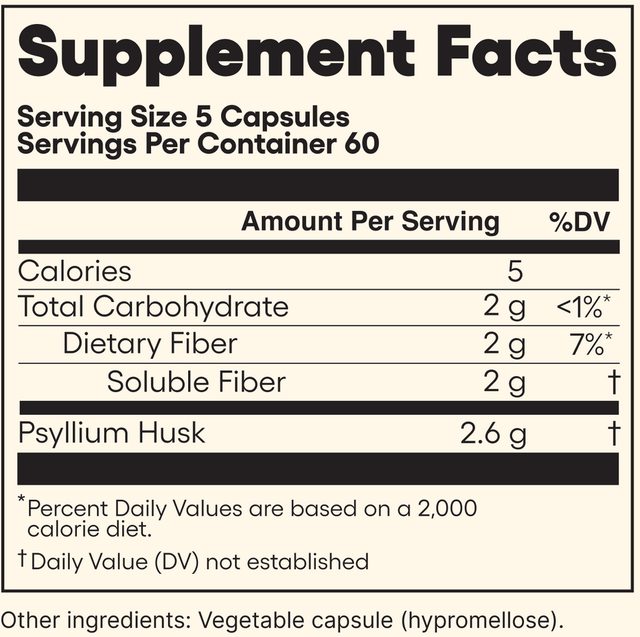
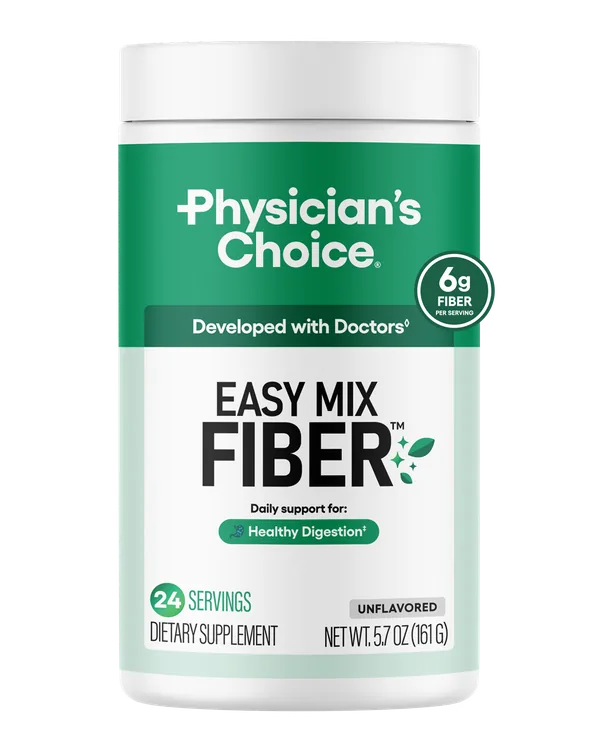
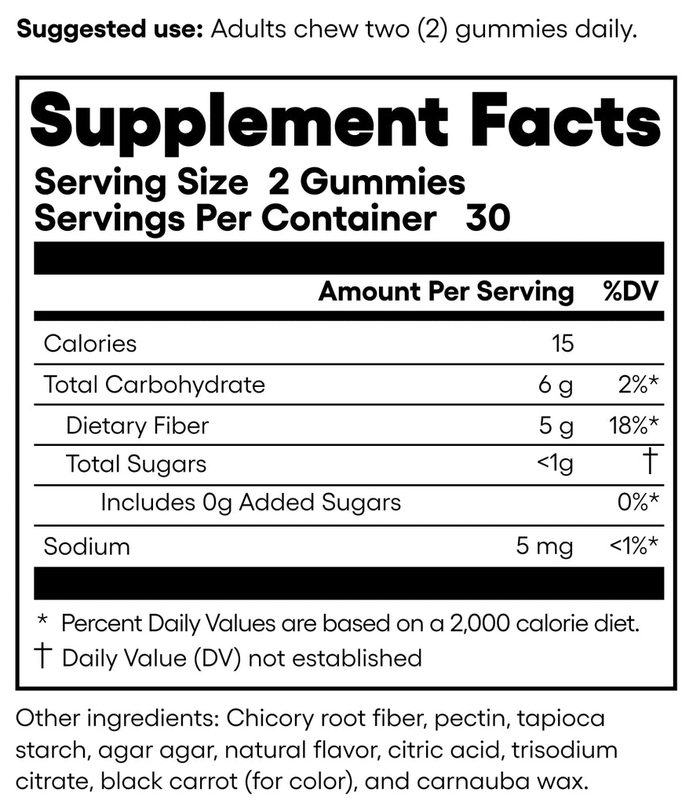
Physician's Choice, which publishes this site, makes three fiber supplements, and each panel names its fiber. The Psyllium Husk Fiber panel prints 2.6 g of psyllium husk and 2 g of fiber, all soluble, per 5 capsules, with 60 servings to the bottle. Easy Mix Fiber prints 6 g of fiber, all soluble, per heaping spoonful (6.7 g), names soluble corn fiber and guar fiber as its fiber, and holds about 24 servings to the tub. Fiber Gummies print 5 g of dietary fiber per 2 gummies, with chicory root fiber first on the ingredient list and pectin second, and 30 servings to the bottle; adults chew 2 gummies daily.12
The fluid advice Physician's Choice gives for all three: Drink plenty of water and other liquids when you take a fiber supplement to help keep things moving. None of the studies above tested these products, and no serving here is set against a study's daily amount. How many grams you need in a day is in how much fiber per day?, and what time of day to take one, and how far from medicines, in when to take a fiber supplement.
In brief
Soluble fiber dissolves in water, then gels, ferments or does some of each. Psyllium, guar gum, methylcellulose, inulin, wheat dextrin and soluble corn fiber are the six soluble fibers on this page, and each has its own study record, from stool frequency in constipation trials to fermentation in a lab model. Read the fiber the panel names and the grams on its Dietary Fiber line.
How we reported this
- Reader questions
- In a pull of 1,145 public Reddit posts (250 communities, Sep 12 to Oct 12, 2026), 20 mentioned psyllium and 1 mentioned soluble fiber; none is quoted here.
- Search question
- "Soluble fiber supplement" with its neighbors, "what is soluble fiber," "soluble vs insoluble fiber" and "is psyllium soluble or insoluble fiber," plus the follow-up AI assistants run on fiber types.
- Label data
- The Physician's Choice Psyllium Husk Fiber, Fiber Gummies and Easy Mix Fiber panels, read on Oct 26, 2026.
- Sources
- Eleven public sources, each fetched and read on Oct 26, 2026: MedlinePlus, Harvard's Nutrition Source, the Linus Pauling Institute, two FDA documents, a 2022 review, four trials and one lab study.
- House wording
- Three lines are Physician's Choice wording, used as written: the fluid line, and the two lines on constipation and pregnancy in the doctor box.
Soluble fiber questions, answered
What is a soluble fiber supplement?
A supplement whose fiber dissolves in water, such as psyllium husk, guar gum, methylcellulose, inulin from chicory root, wheat dextrin or soluble corn fiber. Some of these thicken into a gel and some are fermented by gut bacteria. The Dietary Fiber line on the panel gives the grams per serving, and the ingredient list names the fiber.
Is psyllium soluble or insoluble fiber?
Soluble. MedlinePlus names psyllium among the sources of soluble fiber, and the Physician's Choice Psyllium Husk Fiber panel prints its 2 g of fiber per 5 capsules as all soluble. In a 2022 review of 16 trials in adults with constipation, psyllium raised stool frequency and improved stool consistency and straining.
What is the difference between soluble and insoluble fiber?
Soluble fiber dissolves in water and turns to a gel or is fermented by gut bacteria; insoluble fiber does not dissolve and adds bulk to stool. Oats, barley, beans, lentils, apples and psyllium bring soluble fiber; wheat bran, whole grains, brown rice and leafy greens bring insoluble fiber, per MedlinePlus and Harvard.
Is inulin a soluble fiber?
Yes. Harvard's Nutrition Source lists inulin, found in chicory root, onions, asparagus and Jerusalem artichokes, as a soluble fermentable fiber, and the Linus Pauling Institute classes it as a prebiotic for its ability to stimulate Bifidobacteria in the colon. In a 2017 trial, 12 g of chicory inulin a day raised stool frequency in adults with constipation.
Which foods are high in soluble fiber?
MedlinePlus and Harvard's Nutrition Source name oat bran and oatmeal, barley, beans, lentils, peas, nuts, seeds such as chia, and fruits such as apples and blueberries. Psyllium, the husk of a seed, is the supplement MedlinePlus lists as a soluble fiber source. Neither source gives grams of soluble fiber per food.
Sources
- MedlinePlus Medical Encyclopedia. Soluble vs. insoluble fiber. Review date Aug 25, 2026. medlineplus.gov
- Harvard T.H. Chan School of Public Health, The Nutrition Source. Fiber. Last reviewed April 2022. nutritionsource.hsph.harvard.edu
- Linus Pauling Institute, Oregon State University. Micronutrient Information Center: Fiber. Updated March 2019; reviewed June 2019. lpi.oregonstate.edu
- US Food and Drug Administration. 21 CFR 201.319, Water-soluble gums, hydrophilic gums, and hydrophilic mucilloids as active ingredients; required warnings and directions. Electronic Code of Federal Regulations, current as of Oct 1, 2026. ecfr.gov
- US Food and Drug Administration. Questions and answers on dietary fiber. Content current as of Jul 25, 2024. fda.gov
- van der Schoot A, Drysdale C, Whelan K, Dimidi E. The effect of fiber supplementation on chronic constipation in adults: an updated systematic review and meta-analysis of randomized controlled trials. American Journal of Clinical Nutrition. 2022;116(4):953-969. Funded by a dietitians' association trust; two authors report food company funding. pmc.ncbi.nlm.nih.gov/articles/PMC9535527
- Hamilton JW, Wagner J, Burdick BB, Bass P. Clinical evaluation of methylcellulose as a bulk laxative. Digestive Diseases and Sciences. 1988;33(8):993-998. pubmed.ncbi.nlm.nih.gov/2839321
- Chan TC, Yu VMW, Luk JKH, Chu LW, Yuen JKY, Chan FHW. Effectiveness of partially hydrolyzed guar gum in reducing constipation in long term care facility residents: a randomized single-blinded placebo-controlled trial. Journal of Nutrition, Health and Aging. 2022;26(3):247-251. pubmed.ncbi.nlm.nih.gov/35297467
- Micka A, Siepelmeyer A, Holz A, Theis S, Schön C. Effect of consumption of chicory inulin on bowel function in healthy subjects with constipation: a randomized, double-blind, placebo-controlled trial. International Journal of Food Sciences and Nutrition. 2017;68(1):82-89. Two of five authors worked at the inulin maker's research institute. pubmed.ncbi.nlm.nih.gov/27492975
- Timm DA, Thomas W, Boileau TW, Williamson-Hughes PS, Slavin JL. Polydextrose and soluble corn fiber increase five-day fecal wet weight in healthy men and women. Journal of Nutrition. 2013;143(4):473-478. pubmed.ncbi.nlm.nih.gov/23427334
- Timm DA, Stewart ML, Hospattankar A, Slavin JL. Wheat dextrin, psyllium, and inulin produce distinct fermentation patterns, gas volumes, and short-chain fatty acid profiles in vitro. Journal of Medicinal Food. 2010;13(4):961-966. pubmed.ncbi.nlm.nih.gov/20482283
- Physician's Choice Supplement Facts panels: Psyllium Husk Fiber (label 3.0.0), Easy Mix Fiber (label 3.1.0) and Fiber Gummies (label 3.0.0), label images on physicianschoice.com. Read Oct 26, 2026. The label figures on this page are copied from those panels; the fluid line and the constipation and pregnancy lines are Physician's Choice wording, used as written.